In 1754 the Marathas arrived as the kingmakers in Delhi . The defeat and decline of the Imperial Mughal armies had led to the ethnic tensions between the ruling classes of the Mughals being the Iranis, the Turanis and the much despised Hindustanis. Their erstwhile allies composing of part of the Hindu ruling classes of the Rajputs remained indifferent to theses struggles secure in their mighty forts and castles.
The prime cause of this decline was their great rivals the Marathas – a Hindu warrior clan from the western parts of India who under the leadership of Shivaji (d1680) first shook and then shattered the Mughal dominions. Arising when it seemed like the Islamic conquest of the subcontinent was close to a final success after six centuries of bloodshed Shivaji rose to became the foundation of the mightiest force in India for the next 150 years. In his wake great uprisings from Rajasthan to Assam and from the Himalayan mountains to the deep south as the Hindu revival rose.
The leader of the Turanis (Sunni Muslims) Imad Ul Mulk wished to control the battered remnants of the empire under his own leadership with the support of the Marathas and Rajputs and was against the Iranis (Shia Muslims) under Safdar Jung with the Jats, Persians and Hindu Naga Sadhu battalions.
This plan involved a settlement between the factions under the leadership of the emperor Ahmed Shah and involved a joint challenge to the Marathas who were pouring every north year after year.
Ahmed Shah – the lineal descendant of Aurangzeb immediately settled the arrears of his troops and formed up the newly trained Mughal army and set to lead this new coalition against a large Maratha force led by the regional commander Malhar Rao Holkar who was believed to be at a distance of 100 miles from the capital with an army of 20,000
After leaving his palace on the 27th April 1754 the Mughals reached Sikandrabad on the 8th May of the same year when news reached him that Malhar Rao had left his siege of Kumher and marching towards Delhi with all speed to attack the Emperor. The cowardly Emperor lost his nerve and began to fall back on Delhi despite the Marathas being over 100 miles from his position. After a few weeks of manoeuvres news reached the Mughals on the 26th May that the Marathas had been sighted within 24 miles of the camp. Ahmed Shah mustered his captains and troops and ordered the imperial war drum to be sounded to fall back to Shorajpur accompanied with his minister Roz Afrun Khan , his wife’s sister Dilafroz Begum, his mother Udham Bai his wife Inayetpuri Bai and his sons together with the other ladies, princesses and support staff of his harem
During this march around midday the alarm was sounded and the vast crowd of the Mughal camp was thrown into confusion at the sight of the Maratha horsemen fast approaching
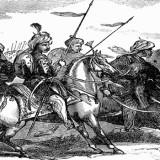
The war experienced Maratha Commander Malhar Rao immediately dispersed his swift moving cavalry in a vast net around the Mughals – his mounted troops opened fire with their matchlocks and then ordered the charge over the uneven and broken ground. The Mughal lines was smashed in the first charge leading to indescribable confusion in the camp. The lines of caravans were broken as soldiers and civilians alike each fled for safety where they could find it only to find the net of their enemies closing in around them.
The Emperor fled on a fast paced mount with his mother and favourite wife and thus escaped but left behind him his family, his wives and daughters and those of the Mughal nobility to the mercy of their Hindu enemies.
A huge amount of gold and coins fell into the hands of the Marathas but the greatest loss was the loss of prestige for the empire- the hardy cavalry of the Maharashtra mountains had in their captivity the honour of the Imperial family, queens and princesses – as the author Sarkar states – never had such a calamity befallen on the house of Timur’
Scattered groups began to reach Delhi behind the fleeing Emperor who to his horror learned of the fate of his family. Many of the caravans and raths were overturned and those of the Mughal ladies were torn apart with their ornaments and clothes being seized and countless of them being dishonored and led into captivity by the Maratha soldiers.
Some fled towards Delhi – others like the kings mother were protected by Malhar Rao who had now arrived. Imad arrived in Malhars camp in humiliation complaining that the Marathas would listen to no one and that he was their slave in this matter.
On the 30th May Malhar Rao sent his demands to the emperor as his troops began to attack the suburbs of the Mughal capital – The capital trembled in terror as the outlying suburbs were put to the sword and set on fire. The memories of the previous year’s sack of Old Delhi by the Jats under Suraj Mal was still fresh in the memory of the Mughal population.
The following day the Emperor agreed to all of the demands of the Marathas. Punjab, Sind and the frontier areas were all ceded to the Peshwa – in effect the Chauth (tribute) of all of South Asia was granted to the Marathas –
The mother of the Emperor was led back to Delhi in the deepest of humiliation and despair – the Mughal courtiers having seen their families and servants led into captivity or humiliated the following day rose against the Emperor and dragged from the prison cells a distance cousin and placed him on the now powerless throne of Delhi – the unfortunate Ahmed Shah was blinded and thrown into a prison cell with his mother dying of natural causes in 1775.
The Marathas continued on their path and even after their great setback at the Battle of Panipat remained the preeminent power in India marching into Delhi on numerous occasions in the next decades culminating in the rise of the great Maratha warlord Mahadji Sindhia who stamped out the very last vestiges of Mughal and Pathan armies in 1788
Then out spoke brave Horatius, the Captain of the Gate:
“To every man upon this earth, death cometh soon or late;
And how can man die better than facing fearful odds,
For the ashes of his fathers, and the temples of his Gods,
And for the tender mother who dandled him to rest, And for the wife who nurses his baby at her breast, And for the holy maidens who feed the eternal flame, To save them from false Sextus, that wrought the deed of shame?
Though one of our worst enemies, this poem of Thomas Babington Macaulay has never failed to move our heathen sensibilities and none exemplify the spirit more than the ancient and now forgotten Hindus of Armenia who died defending the temples of their Gods even though their cause was hopeless against the Christian fanatics.
According to the Syrian writer Zenob, a disciple of “St.” Gregory and a witness to this tale, the Hindus of Armenia descended from two Hindu princes named Gissaneh and Demeter of Kanauj who fled to Armenia around 149 BCE after they were caught conspiring against their king Dinakspall. They were supposed to have been welcomed along with their followers by King Valarsaces of Armenia and given the province of Taron (western Armenia, now Turkey) where they built a city called Veeshap. They then proceeded to install the Hindu Gods alongside the national Gods of the Armenians in the city of Ashtishat, famous for its temples.
An inscription from the Baku Atashgah. The first line begins: I salute Lord Ganesha (श्री गणेसाय नम), the second venerates the holy fire (जवालाजी, Jwala Ji) and dates the inscription to Samvat 1802 (संवत १८०२, or 1745-46 CE).The Persian quatrain below is the sole Persian inscription on the temple[7] and, though ungrammatical,[7] also refers to the fire (آتش) and dates it to 1158 (١١٥٨) Hijri, which is also 1745 CE.
We presume that the deities Gissaneh and his brother, Demeter must be the vr.s.n.i kula warriors Kr.s.n.a and Balabhadra. Demeter is the Greek Goddess for harvest and Balabhadra with His halAyudha very much qualifies for the title Demeter.
In 301 CE the bearer of the Christian plague “St.” Gregory converted the Armenian ruler Tiridates III and thereby inaugurated a reign of terror on the heathens of the land. Armenian pagans were converted by force. The temples of Gods were destroyed to make way for pretAlaya-s. The tiny Hindu minority were also targeted by Gregory. This made the world to witness the grand resistance offered by these few Hindus with the meager resources available. It was the first time that Hindus had to face the iconoclasm of Abrahamic traditions. Faced against great odds, the Hindu civilians fought battles against the well trained Armenian army in order to defend their dharma and their Gods. KavirAja bhUs.an.a said:
These words especially apply to those Armenian Hindu brethren who breathed courage such that they fought for their dharma against all odds and preferred death to ignominy. Those Hindus had indeed internalized the teaching of Kr.s.n.a – “svadharme nidhanam s’reyaH” (gItA – 3.35) – To die following one’s dharma is indeed most excellent and preferable – than giving up one’s dharma for something else.
War Breaks Out
Let us go to the vivid description, given by Zenob, of the resistance offered by the miniscule minority community of Hindus against the Armenian armies. Soon after the conversion of the king, the Hindus got wind of the Christian plans to demolish their temples of Gissaneh (Krishna) and Demeter as they did with the Armenian temples. The Hindus removed the temple treasures to a safe place at night and sent messages to the arcaka-s of nearby village, Ashtishat, to collect an army and join them to resist.
Zenob gives us the message sent as follows:
“Gather every man who is a warrior and hasten to reach us tomorrow for the great Gissaneh (Kr.s.n.a) will go into battle against the apostatizing princes.”
An inscription from the Baku Atashgah. The first line begins: I salute Lord Ganesha (श्री गणेसाय नम), the second venerates the holy fire (जवालाजी, Jwala Ji) and dates the inscription to Samvat 1802 (संवत १८०२, or 1745-46 CE). The Persian quatrain below is the sole Persian inscription on the temple[7] and, though ungrammatical,[7] also refers to the fire (آتش) and dates it to 1158 (١١٥٨) Hijri, which is also 1745 CE. An invocation to Ganesha, Jwala Ji and Lord Shiva(?) from the Atashgah in Baku, Azerbaijan. The inscription is in Sanskrit written in the Devanagari script. Note the devotional (dotted, with slanted ends) Hindu swastika on the top.The pretAcArin had expected no real resistance as he proceeded with three princes and the three hundred men without a care. He must have thought that with the strength of the Armenian royalty at his side, no one will dare to rise against him, especially the small minority of Hindus. But the Hindus of Armenia were born to prove what BhUs.a.n.a wrote 13 centuries later.
When the Armenian troops had ascended the hill where our brethren had stationed themselves, Arjun caused the battle horns to be sounded and came out with his men to attack the Armenians with full might. The Armenians responded as though the great archer Arjuna himself was blowing his conch devadatta and attacking them. The fear, which filled the hearts of the kaurava army when Arjuna was seen in virAt.a battle, came to occupy the hearts of the Armenians upon seeing the gleaming standards of the Hindus who had come to defend their Gods and dharma to death.
The princes sent the pretAcArin to safety with three riders and tried to hold back the Hindus. The Armenian forces who tried to stop the surging Hindus were put to death. Hindus of nearby village had also gathered along the way of Armenian retreat and began to chase the pretAcArin and his men. Gregory took refuge at the fort of Vogkhan. Hindus laid siege to it. The Armenians had to beg for help from a nearby prince who came with an army of 4000 men to beat the Hindus back with his superior numerical strength.
Arjun rallied his forces at the same hill where he had defeated the Armenians earlier and began to curse the Armenians for abandoning the Gods of their ancestors. Zenob reports the following conversation:
“Advance,” he said, “O you who are irreligious and who have forsaken your nation’s Gods; you who are the enemies of the glorious Gissaneh. Do you not know that the great Gisaneh has come out in battle against you and he will deliver you into our hands and will strike you with blindness and death.”
At this an Armenian prince rushed forward and said “Oh you braggart, if you are fighting for your gods, you are false, and if it is your for your country, you are altogether foolish for behold the prince of the house of Angegh and the prince of the house of Sunnies and the other nobles whom you know but to well.”
To which, Demeter, the son of Artzan replied thus.
“Listen unto us O you Armenian princes, it is now forty years since we are engaged in the service of the mighty gods and we are aware of their powers, for they fight themselves with the enemies of their servants. We are not, however, able to oppose you in battle for this is the house of the king of Armenia and you are his nobles, but let it be known to you all that although we cannot possibly conquer you, yet it is better for us to die a glorious death to-day in upholding the honor of our Gods rather than live and see their temples polluted by you. Death is, therefore, more welcome to us than life. But you, who are the prince of the house of Angegh come forward and let us fight singly.”
What better words could have come from the mouth of this son of Arjuna!! We are indeed reminded of Abhimanyu, who preferred fighting to death against insurmountable odds. Here, we have a son of another Arjuna from a later era. But we see the same flame for dharma burning brightly within him, filled with courage to the brim.
Such a sacrifice for dharma has never been alien to Hindu history. When Alexander invaded our lands, brAhman.a-s exhorted the local rulers to stand up to that barbarian. Alexander is said to have furiously targeted the brAhman.a community as they made the entire western AaryAvarta to rise in revolt against him. Greeks mention several small cities which stood up to Alexander and fought till the last man rather than submit to him. Where the Persians had submitted to Greeks meekly, Hindus of even small states gave a tough time to the Greek conqueror. Later, during the invasions of Muslims, we find jauhar and saka being performed by Hindus where the women immolated themselves to death and men fought to death against insurmountable odds. This was done to avoid the ignominy of being forced to change one’s svadharma. The same ideal is echoed in the words of this Abhimanyu from Armenia who roared that they will die a glorious death upholding the honor of Gods rather than live to see their temples being polluted by the pretAcArin’s men.
Sacrifice for Dharma – Death over apostasy
In a single combat between the old Arjun and an Armenian prince, Arjun managed to inflict wounds on the prince but the prince managed to cut Arjun to death. While the Armenian troops were rejoicing about this victory, Hindu civilians led by their arcaka-s came to that hill and began attacking the Armenians with great vengeance. When the Armenian troops tried to flee downhill, Hindu infantry threw rocks and weapons from atop causing damage to their cavalry while the villagers who gathered at the foothills began to attack the fleeing Armenians. The trained Armenian army was then rallied around by the princes who managed to get a foothold on one side of the hill and held it when the sun began to set – battle was called off at that juncture.
On the next day, as per Zenob, Hindus had managed to gather 6946 men while Armenians had gathered 7080 troops. There were other Armenian troops numbering a few thousands in the vicinity – who were indulging in looting and destruction of the Hindu villages. Where the Hindu army consisted of local Hindu civilians who had come to defend their temples and dharma, Armenian army consisted of trained warriors. The advantage of a well trained army began to show when Armenians began to gain upper hand over the Hindus. A sliver of hope came to Hindus when a vassal prince of Hashtyank, who was a Hindu, switched sides to join his Hindu brethren against the pretAcArin’s hordes. Armenian troops were clobbered under his leadership – he was well known to be a great warrior and leader. But the hope was shortlived as the other Armenian princes rallied their troops again and one of the princes managed to behead the prince of Hashtyank. Demeter, the son of Arjun, managed to kill the son of an Armenian prince. But this was not enough to stop the well trained Armenian troops.
The grim scenario of defeat, which was expected by the Hindus but welcomed to avoid a meek surrender, came clear later in the day when the leaders of their army, the temple arcaka-s fell in the battle one after another. Demeter, the son of Arjun and their last leader left, was also beheaded and his head was collected in a sack by an Armenian prince. 1038 Hindus were killed in this battle and the rest were captured alive & stripped naked.
The local Hindu priests buried their dead there and also proceeded to bury the dead Armenians. The place was marked with the following inscription as per Zenob in Syriac and Greek:
“This was the first battle of Artzan, the high priest and a great warrior. He is buried here and with him are 1038 men. And we fought this battle for the idols of Gissaneh and Demeter and for Christ.”
Gregory, the pretAcArin, was brought back and he ordered to destroy the murtis of Kr.s.n.a and Balabhadra. Six arcaka-s of the temple, who were alive at that time, fought the Armenians who had entered the temple. The arcaka-s had stated
“Let us die first and then let the great Gissaneh be destroyed!”
This reminds us of those rAjpUt warriors who defended the temples to their last breath. Kavi PadmanAbha records how the warriors died defending the temple of SomanAtha during the reign of Ala-uddin. The beginning of this tradition was made in Armenia by the small community of Hindus. Even as late as 18th century, 3000 rAjpUt-s entrenched themselves in the temple of S’rI ran~gam to save the temple from the European AtatAyin-s. They vowed to defend the temple from intrusion of any non-Hindu until the last one of them was alive. This prevented the victorious British from indulging in any misadventure within that temple. The fire lit at Armenia was kept burning here by successive generations of Hindu warriors who preferred death to apostasy. This indifference towards death and firm resolve to defend dharma have been the main source for the Hindu resistance movements under the Muslim yoke.
Gregory destroyed the two temples (of Kr.s.n.a & Balabhadra) and built a pretAlaya over the remains. An arcaka was caught alive and he was tortured to find out the location where the temple treasures were hidden. But the arcaka remained true to His dharma and did not utter anything – preferring to embrace death than lead the barbarians to the treasures.
Gregory then had the civilians of the Hindu villages converted to his preta cult. 5000 men and youth apart from women were baptized. After this, he collected the children of the arcaka-s and the attendants of the temples – numbering 438 in all. He offered to baptize them as well. The children replied
“Keep this in mind, as long as we live, we shall seek revenge upon you; even if we should die, the Gods will exact their revenge”
One Armenian prince ordered to shave their head (the Hindus had sported s’ikhA-s) and sent these brave children to prison. Nothing is heard about them after this. We can imagine what their fate would have been. These brave young souls faced their end with the grace of seasoned warriors – preferring a torture and death to the dishonor of abandoning their Gods.
Zenob also notes that while the Hindu civilians had been converted. They still had not given up their ancestral religion. Hindus continued to ensure that their children sported s’ikhA and the worship of their Gods was maintained in a clandestine manner. Zenob warns the pretAcArin-s to be attentive towards this tendency of Hindus, lest this practice spread in other lands. We hear nothing about Hindus in Armenia after a century or so. It seems that the Christian fanatics destroyed the remnants of these Hindu communities so thoroughly that nothing is left now.
Thus ended the first struggle between the Hindus and the Abrahamic fanatics. Where the Armenian heathens were cowed down by the might of the army, Hindus put up a brave struggle – setting stage for the centuries of struggle that followed in order to protect their religion and traditions. While we have lost half of our lands and people due to numerous mistakes on our part, we cannot deny that our survival has also been due to the single biggest strength of dharma – it inspires its followers to face even insurmountable odds than submit meekly. It gives us courage to face our enemies.