Rao Tula Ram Ahir

Most people familiar with India’s capital, Delhi, will likely have used the nation’s main international airport, Indira Gandhi International. En route from the airport to the centre of Delhi is a long and famous road, Rao Tula Ram Marg (‘Marg’ being the Hindi word for street). Situated on this road is one of Delhi’s finer higher education institutions, Rao Tula Ram University. All this leads to the question, “who is this Rao Tula Ram?”

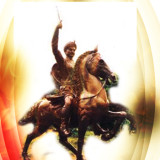
Rao Tula Ram was one of the prominent leaders of the Indian Uprising of 1857 against the colonial British forces. His story is one of rebellion and guerrilla warfare against the stronger and better-equipped imperialist forces of the British Army.

He was born on 9 December 1825 in the well known Rao family in village Rampura in the district of Rewari (a two-hour drive south-west of Delhi), in what is now Haryana. His father was Puran and his mother’s name was Gyan. He was educated according to the then prevalent customs and he knew Persian, Urdu, Hindi and a small amount of English. In November 1839, Rao Tula Ram ascended the throne on the death of his father.

In 1857, on hearing the news of rebellion at Meerut and other places, the people of the Rewari rose up to support the uprising. In the Rewari area, lead was given by Rao Tula Ram. His cousin Gopal Dev also stood by him. The forefathers of the Raos had helped the Marathas in 1803 in the Second Anglo-Maratha War. The British confiscated their land and gave instead an ‘istamarari’, or grant, of about 58 villages. This was a great blow to the Raos, who were itching to fight the British Raj at the first available opportunity.

On l7 May 1857, Rao Tula Ram went to the ‘tehsil’, or headquarters, at Rewari with four to five hundred followers and took all the government buildings in their possession. For their headquarters, they chose Rampura, a small fortified village, one mile south-west of Rewari. Tula Ram, the elder Rao became Raja and Gopal Dev his commander-in-chief. After assuming charge, Rao Tula Ram organized the revenue department and collected revenue and taxes. He took donations and loans from the people of Rewari. He raised a force (about five thousand men) and set up a large workshop in the fort of Rampura where a substantial number of guns, gun-carriages and and ammunition were manufactured. Law and order was enforced.

At this time, Delhi was under attack from the British forces, so Rao Tula Ram helped the emperor Bahadur Shah in their fight against the British. But this help could not protect Delhi which fell to the British on September 20, 1857. Soon after Brigadier-General Showers led out a column (from Delhi) of 1,500 men with a light field battery, 18 two-pounder guns and two small mortars, “to attack and destroy Rao Tula Ram and his followers and to raze his fort (at Rewari).” The situation was serious and the Rao foresaw that a fight with the British forces in the mud fort of Rampura, in the changed circumstances after the fall of Delhi, would result in the complete destruction of his army without any serious loss to the British. So he left his fort before Showers’ arrival.

The fort of Rewari was taken by the British without any opposition on October 6th. Immediately after the occupation of Rewari, Brigadier-General Showers sent a messenger to Tula Ram telling him that if he submitted along with guns and arms, he would be treated on merits. But Tula Ram turned down the inducement and sent a strong column comprising about 1,500 troops under Colonel Gerrard, an officer of conspicuous merit on November 10, 1857. The column reached Rewari three days later. They occupied the abandoned fort of Rampura. Here they were joined by two squadrons of the Carabineers.

After a few days rest at Rewari (Rampura), on November 16, Gerrard marched to Narnaul. As the track was sandy, the column reached Nasibpur, a small village, two miles northwest of Narnaul and halted for a short rest. The rebel force, having abandoned their strong fort in the center of the town pounced on them. Rao Tula Ram’s first charge was irresistible and the British forces scattered before them. The Patiala Infantry and the Multani Horse on the British side were completely disheartened. But at this juncture, the Guides and the Carabineers came to their rescue and saved the situation. The British artillery was too much for the rebels. But soon the situation took an unexpected turn when Col. Gerrand was mortally wounded by a musket ball.

With this, the British too, were demoralized. Taking full advantage of the circumstances, Rao Tula Ram swooped down upon them. The British could not stand the charge and the Multani Horse fled away in bewilderment. They recaptured their guns and inflicted heavy losses on the enemy. The right and the left wings of the British forces were thrown into confusion.

Appreciating the gravity of the situation Major Caulfield, the officiating British Commandant, ordered his artillery to start heavy bombardment and his cavalry and infantrymen to charge straight on with full force in to their front ranks. Rao Tula Ram’s forces fought back furiously and stood their grounds. The British artillery fire, nevertheless, broke their backbone and split their forces into two parts – one engaged in the close quarter battle and the other fleeing to go out of the range of the British guns. Rao Tula Ram was defeated that day but managed to flee to safety. His escape frustrated the British.

The battle of Narnaul was undoubtedly one of the most decisive battles of the Uprising of 1857. The English felt jubilant over their success in this confrontation, for it marked the “beginning of the end” of the crucial period of the struggle in the Haryana region and northern Rajasthan. After the battle, Rao Tula Ram moved into Rajasthan; then joined Tatya Tope’s forces for one year. On 1 November 1858, the British issued the promise of unconditional pardon and amnesty to all the “mutineers” except those who directly or indirectly took part in the murder of British subjects. Rao Tula Ram knew that with the blood of many British soldiers and subjects on his hands, this did not include him. He left India for Iran in 1862. 

Once the uprising of 1857 was over, the wrath of the British was unleashed. People in the Rewari and Narnaul areas were hung or shot dead and their villages burnt. In Iran, he plotted revenge against the British. From Iran he travelled to Afghanistan, where tragically, in the winter of 1862, he died after becoming ill in Kabul at the young age of 38.

by  Tarunpal Singh Yadav

(2232)
Jnanadeva the Poet Yogi

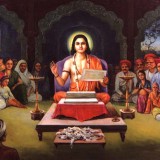
Jnanadeva (also written as Jnandev, Jnanesvar, Jñanadeva or Dnyāneshwar) was a Hindu saint of the Nath tradition, who lived in Maharasthra  in the 13th century during the rule of the Yadava King Ramadevarao, immediately prior to the Islamic invasions of that part of India which started in 1296. Ramadevarao provided a stable and secure government compared with the political turbulence and persecutions which were then taking place in many parts of India, and thus his kingdom attracted saints and scholars and became one of the epicentres of Hinduism in that era.

In his short life, which is believed to be no longer than 22 years, Jnanadeva composed a rich body of spiritual writings [Amritanubhava, the Abhangas, the Jnanesvari and the Changadeva Pasashti], which are considered great milestones in Marathi literature.

Jnanadeva translated the Bhagavad Gita into Marathi and provided a magnificent and rich commentary, which appealed to common folk as well as great saints and scholars. This work was named Bhavartha Deepika (Light on the Inner Meaning); however it more commonly goes by the name “Jnanesvari” in honour of its composer. This work is still widely studied and recited today. An English translation of the Jnaneshwari is available here.

Jnanadeva lived at a time when common folk would would practice forms of religiosity which were not in tune with the main thrust of spiritual Hinduism, and did not provide practical guidance in life, which is supposed to be the journey of the soul to ever greater heights. Most Hindu scholars of the time did not wish to translate central works of Hinduism such as the Bhagavad Gita or the Upanishads into local languages. It was widely held that Sanskrit was the only language fit for this purpose. However the scholars and pandits did not realise that their short-sightedness was depriving the masses of the spirituality and ethical guidance which they needed in their lives.

Jnandeva broke this taboo and was one of the foremost pioneers of that time who did this, paving the way for an entire movement which lasted many centuries, in which the core of Hindu spirituality was made easier to read, practice and imbibe. This was instrumental in Hinduism  surviving the long hostile medieval period in when parts of India was under Islamic rule, by greatly stemming the tide of forced and voluntary conversions away from Hinduism. Amongst Jnandeva’s teachings was the spiritual equality of all castes and backgrounds that made up the Hindu community, the ultimate oneness of Shiva and Vishnu, and an emphasis on physical (hatha) yoga.

Amongst the saints who Jnanadeva’s works inspired were – Namadeva, the tailor’s son, Narahari, the goldsmith, Gora the potter, Chokamela and his wife, who from “Dalit” background, and Janabai, the maid servant. Additionally, the entire “Bhakti movement” bears a deep influence from Jnanadeva. In the centuries which proceeded his life, the seed which he created blossomed and many other great seers and upholders of Hinduism in that land came forth, such Eknath, Tukaram and Ramdas. It is not inaccurate to say that the great political renaissance of Hinduism that occurred in Maharasthra which was the first region to decimate the Moghuls owes much to the renewed faith in people’s hearts that was imparted by Jnanadeva, some centuries earlier.

Jnanadeva decided on a practice of voluntary ending his life in a state of deep meditation, once he felt that his life mission was complete – he was buried alive in a deep meditative state. It is believed that it was in 1296 that he took his last bath, and descended the steps into the Samadhi that had been prepared for him. Sitting in the padma yogic position and facing North, he voluntarily released his mortal coil.


The Bhavartha Deepika (Light on the Inner Meaning, Jnanadeva’s famous book on the Bhagavad Gita is available in English to read online, at the following URL: http://www.bvbpune.org/dnyaneshawri.html

(1251)

Sister Nivedita : India’s Irish Daughter

Sister Nivedita (1867 – 1911) was a famous and inspirational social worker and educationalist in pre-independence India. She is considered to have played an important role in raising national consciousness in India, becoming a relatively early advocate of complete Independence of India from British rule which included supporting the activities of freedom fighters. She is also one of the first persons of the modern age to have adopted Hinduism.

Her birth name was Margaret Elizabeth Noble and was born in County Tyrone, Ireland, on 28 October 1867. She was the eldest daughter of Samuel Richmond and Mary Isabel. The Nobles were of Scottish descent and had been settled in Ireland for about five centuries.

She became a teacher, and held a number of teaching posts before founding a school of her own – `Ruskin School’ in Wunbkedib. Her remarkable intellectual gifts made her a well known figure in the field of education.

She was a religious seeker, whose search for the truth led her away from the strict dogmas of Christianity. Her seeking led her in 1895-96 to Swami Vivekananda’s teachings of the Vedanta (`Complete Works of Sister Nivedita’, II 471). Later in India she followed the teachings of Sri Ramakrishna, and was particularly devoted to Kali and Shiva of the Hindu deities.

She came to Calcutta on 28 January 1898, was initiated into Brahmacharya (a celibate yogic order) and was given the name `Nivedita’ by Vivekananda on 25 March.

Over time she became intensely active in her work of uplifting India. She opened a school for Hindu girls in November 1989, joined plague relief works of the Ramakrishna Mission from March 1899, went abroad in July to collect funds for her school, formed “The Ramakrishna Guild of Help’ in America, went to Paris in July 1900 (where Vivekananda attended the Congress of the History of Religions), left for England alone in September 1900, and returned to India in February 1902.

Sister Nivedita’s interest in the Indian political struggle for Independence led her to be disowned from the Ramakrishna Order after Vivekananda’s death in July 1902. Sister Nivedita’s work however continued, undeterred. She went on lecture tours throughout India from September 1902 to 1904 to inspire more Indians to work for the uplift of the country in all fields; which included a renaissance in the country’s spiritual and cultural traditions.

The supreme goal towards which Nivedita worked was to see India emerge as a self-sufficient, strong and confident nation. Initially Nivedita stated that she desired to see England and India love each other, and did not intend this to necessarily mean full Independence from British rule (`Sister Nivedita’ by Atmaprana, 1967, p. 59).

But later she was embittered and disillusioned by witnessing the effects of British policies in India – in particular the resultant famines and the effects of British education policies in creating an alienated class of Indians. From 1902 onwards she spoke and wrote against the British policy in India, and actively supported revolutionary forces to fight the British with arms.

In 1905-06 she was actively associated with all manner of Indian public affairs; but the strain of her efforts in the relief work in the flood and famine-stricken areas of East Bengal in 1906 broke her health. In August 1907 she left for Europe and America, and returned to India in July 1909.

She went to America again in October 1910, and returned in April 1911. In October 1911 she went to Darjeeling where she resided for a while, but over time her health continued to deteriorate, and she died on 13 October 1913.

Nivedita wrote extensively and has left behind a legacy of works which are worthy of study today. Her innumerable articles were published in journals like the Review of Reviews, the Prabuddha Bharata, the Modern Review, etc.

Her first book was `Kali the Mother’ (1900). Of her principal works the `Web of Indian Life’ (1904) gives a more positive picture of traditional India, compared with the harsh criticisms of everything Indian which were then in vogue in English literature, and the `Master As I Saw Him’ (1910) is an interpretation of Vivekananda’s life and teachings.

She attacked British politicians such as Lord Curzon for the Universities Act of 1904, and for his brazen insults frequently hurled at Indian culture and people, and for the clear attempts to incite Muslims in order to retard the Indian freedom movement. She was distressed by the disastrous condition of Indian economy and held British Imperialism responsible for it. Her politics became active and aggressive and she lost patience with moderate politics of the petitioner. Yet she was friendly with leaders of all schools of political thought like G. K. Gokhale and Bepin Chandra Pal, and young revolutionaries like Taraknath Das.

Image of Sarada Devi and Sister Nivedita sitingShe encouraged and whole-heartedly supported the Swadeshi (self-reliance) Movement both in principle and in practice. She helped nationalist groups like the `Dawn Society’ and the `Anusilan Samity’; was a member of the Central Council of Action formed by Sri Aurobindo Ghose and took up the editorship of the Karmayogin publication when he left British India.

She wanted the whole nation to learn about India from an Indian perspective rather than foreigners studying India (`Complete Works of Sister Nivedita’, IV, pp. 329-53).

She encouraged the study of science, and helped notable Indian scientist Jagdish Chandra Bose in publicising his theories and discoveries. She believed that a rebirth of Indian Art was essential for the regeneration of India. She is said to have inspired Rabindranath Tagore, who later won a Nobel Prize for his tremendous literature.

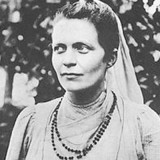
Nivedita was a unique and important figure in the galaxy of the twentieth century Hindu revivalists and her memory should be enshrined in the hearts of Hindus. Tall and fair, with deep blue eyes and brown hair, Nivedita was an image of purity and austerity in her simple white gown and with a rosary of rudraksha round her neck.

A person of intense spirituality, force of character, strength of mind, intellectual power and wide range of studies, she could have achieved distinction in any sphere of life. Yet with unique self-effacement she lived a simple and austere life dedicated to the cause of India and Hinduism, on which the western world had systematically poured contempt.

She was described as `a real lioness’ by Vivekananda, `Lokmata'(the mother of the people) by Rabindranath Tagore, and `Agnisikha’ (the flame of fire) by Aurobindo Ghose. In England she was known as `The Champion for India’, but who above all was a ‘Sister’ to the Indian people whom she loved. Her contribution to the promotion of national consciousness is immeasurable. “My task is to awaken the nation,” she said once. Even today her book ‘Cradle Tales of Hinduism’ is read to children world wide, infusing them with the essence of Hindu consciousness. It was her dream to see in India a true re-establishment of Dharma, that is, national righteousness.

(3856)

Church Bells of Vasai Fort

After the Marathas defeated the Portuguese in 1739 all the churches and building in the fort where captured by the Marathas.

The bells from the churches were paraded, carried off on elephant backs as victory souvenirs. Number of bells in the fort are unknown but four bells are located. One such Bell was carried to and located at Naroshankar Temple on the banks of Godavari river in Nasik, Panchavati area.

The other church bell is located at Bhimashankar Temple is located in the village of Bhorgiri 50 km north west of Khed . Third bell is located at Meneshwar temple in Menavali near Panchgani . This bell weighs six hundred and fifty kilograms. The date on the bell shows the year 1707 and has five-alloy bell bears a bas-relief of Mary carrying the infant Jesus Christ cast into it. Fourth church bell is located at Durga Devi temple, Murud

This bell weighs six hundred and fifty kilograms. The date on the bell shows the year 1707 and has five-alloy bell bears a bas-relief of Mary carrying the infant Jesus Christ cast into it. Fourth church bell is located at Durga Devi temple, Murud

Church bell at Naroshankar temple and is called “Naroshankarachi Ghanta”

This church bell is located at Bhimashankar Temple is located in the village of Bhorgiri, near Khed.


Bell house at Meneshwar temple, Menavali,

Closer up of the Church Bell in Meneshwar temple showing Mary and Jesus


Bell Housein Meneshwar temple, Menavali


Church bell from Vasai/Bessein fort is located at Durga Devi temple, Murud.

Church bell on left in Durga devi temple, Murud.

(1913)