Sambhaji 1689 Official Theatrical Trailer

Perfect Plus Entertainment & 3R Cinemagic in association with FIF Productions Presents “Sambhaji 1689” the most awaited film of 2013.

A True History written by blood, of a Great Warrior Sambhaji son of Shivaji Maharaj never seen before.

A Film by: Rakesh S. Dulgaj
Producer: Mr.Perfect Plus
Associate Producer: Farha Ayaz Ghani
Story & Screenplay: Suresh Chikhale
Music: Avinash – Vishwajit, Guru Sharma & Aarv

More on Sambhaji : A Heroic Death that Changed the Course of Indian History

(24357)

Lachit Borphukan : A Hindu Warrior Par Excellence

The Hindu Civilsation has given birth to many sages and warriors over its long history to survive and this is a short story of one of its greatest sons mostly known only within Assam but unknown sadly among most Hindus themselves..

In the mid 1600s the Mughal Empire was in the noontide of its glory – one of the greatest and largest empires in the world with a power army to match it. By force and conciliation it had overrun a large part of India before their fanatical policies of religious persecution led to a series of uprisings and revolutions that brought the entire empire crashing into the dustbin of history.

The Mughal Court

The Once Powerful Mughal Court

The event which is regarded as the keynote defeat of Mughal armies and the beginning of the fall of the Mughal Empire was the victory of the greatest Assamese Hindu warrior, Lachit Borphukan, who defeated the Mughals in the historic battle of Saraighat in April 1672.

Tezpur in Assam

The Mughal Emperor sent his greatest general, Mir Jumla, to conquer the land of Assam which was ruled at that time by the Hindu Ahoms. This valiant tribe had repulsed numerous attacks on their homeland from the time of Muhammad Ghori to the present, defeating no less than seventeen invasions.

A desperate fight ensued in the jungles and the valleys where the people rallied by Lachit Borphukan and the Hindu monks of the land in a war of liberation.

Ahom shiva temple

Ahom shiva temple

From the capital city of Guwahti to the depths of the forests the Ahoms fought and held back the tide of invasion. The proud warriors of Central Asia, Mughal and Pathan alike were foiled by the valiant resistance of the Ahoms.

Apart from being the headquarters of the Mughal Governor in occupied Ahom territory, Guwahati had great strategic importance. The Brahmaputra river between Kamakhya and Saraighat is the narrowest at Guwahati and there are hills on both banks of the river in this area.

Ahom Warriors about to attack

Ahom Warriors about to attack

The area was densely forested and road communications were very poor. The Brahmaputra waterway was the most important line of communication. A large army moving in this region had to make use of the Brahmaputra waterway. Lachit first struck at Bargoda fort at the junction of Bar Nadi and the Brahmaputra.

The Mughal garrison was driven out from this fort and their counterattacks defeated. The Mughal reserves came up to the north bank and prevented further Ahom advance but could not dislodge them from Bargoda. Lachit Borphukan now shifted his attention to Sukreswar hill on the south bank where the Mughals had a fort, which was also the headquarters of the Mughul Governor. Ahom commandos managed to infiltrate the fort and neutralised the cannons by pouring water through their mouths and over their stock of gunpowder.

lachit borphukan leading the advance on the Brahmaputra

lachit borphukan leading the advance on the Brahmaputra

This was followed by a heavy cannonade by the Ahoms and a determined assault of the fort. Sayed Firoz Khan, the governor, was taken a prisoner. The Mughals abandoned Guwahati. Lachit Barphukan now advanced down the Brahmaputra to Manas recovering all the Ahom territory ceded to Mir Jumla. A stone victory pillar in the Guwahati museum has an inscription in Sanskrit praising Lachit Barphukan for his great victory against the Mughals.

An incident in the history of the Hindu Ahom resistance marks the spirit which animated their fight for freedom, when Lachit Borphukan, the Army General of Ahom king Chakradhwaj Singha had beheaded his maternal uncle for dereliction of duty while preparing to face the Mughals. His execution of his own uncle for not showing sufficient dedication to the war effort was not just an act of impulse but a reminder to his soldiers that in the service of one’s Dharma, it is not possible to adopt double standards of judgement.

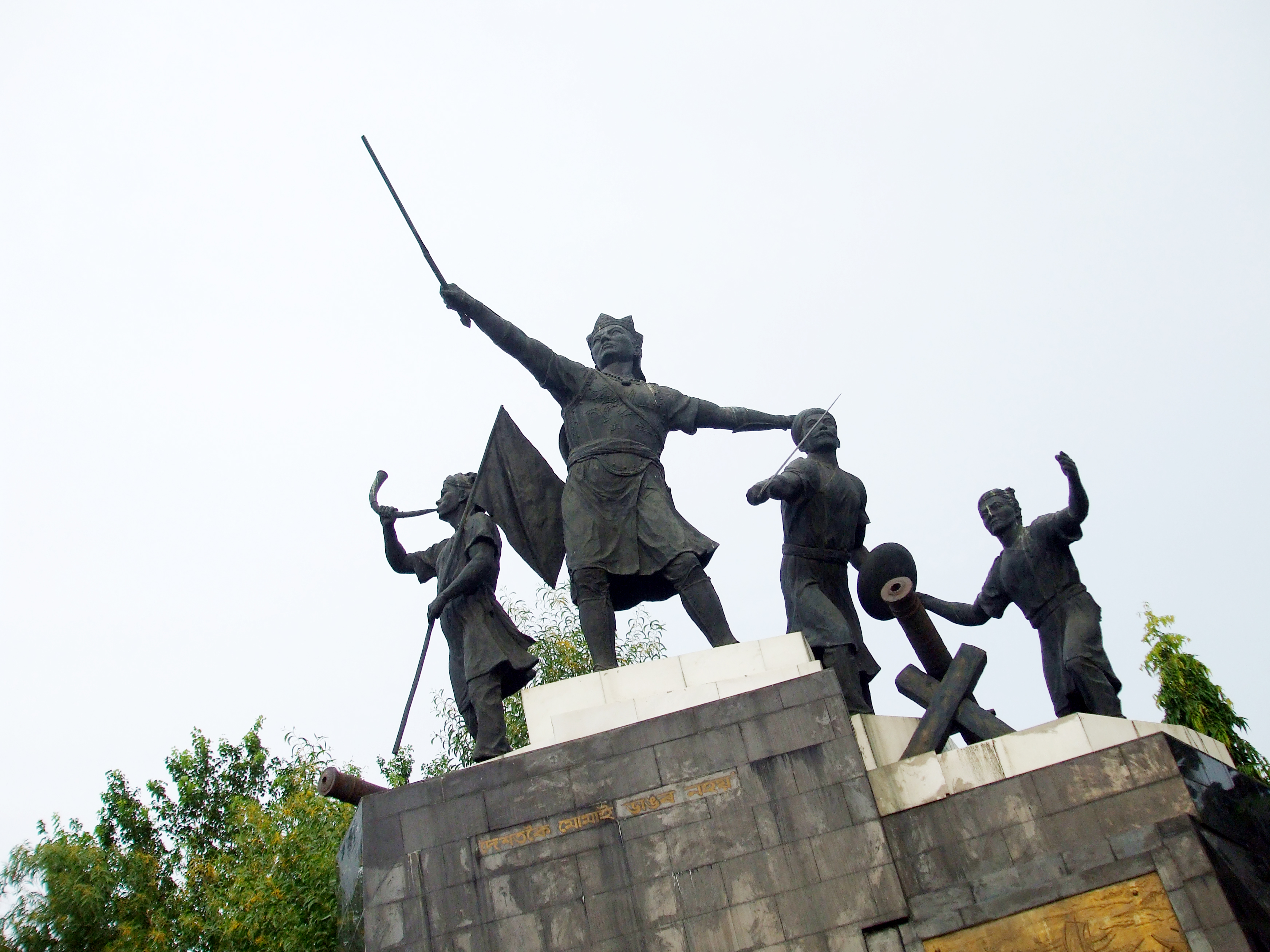
Lachit Borphukan memorial

Lachit Borphukan memorial

Historians may have neglected Assam but history has not. History text books give details of the Indus Valley civilisation, the Ganges Valley civilisation and the Mughals, the British etc but they hardly mention the Brahmaputra Valley civilisation, when the history of Assam is unique. Unlike some Indian states, Assam did not succumb to the invasions of Delhi Sultans of Mughal Emperors and bloodthirsty tyrants and are a reminder of the preservation of freedom of thought and culture – the keystone of Hindu Dharma

Hindu Dharmashãstras have enjoined upon every Hindu to repay according to his or her capacity the rishi-riNa, that is, the debt we owe to our seers and sages, by passing on to the next generation the Veda and the Itihãsa-PurãNa, that is, the spiritual and cultural vision of Sanatana Dharma and the historical tradition of Hindu heroism…  : Sita Ram Goel
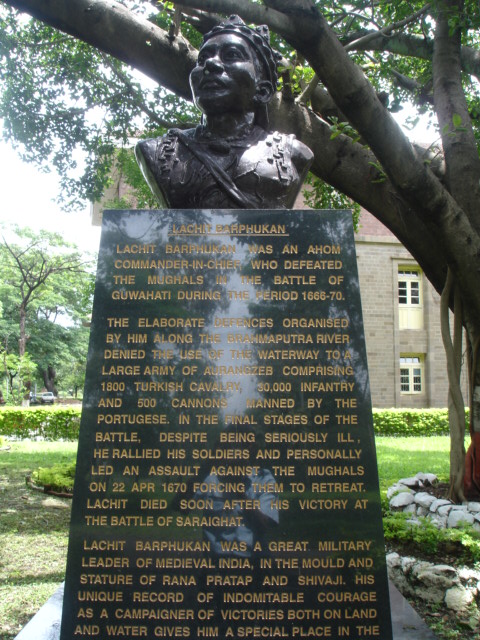
Statue of Lachit Borphukan at National Defence Academy India

Statue of Lachit Borphukan at National Defense Academy : India


(10121)

Video : Maharani Lakshmi Bai’s birth place lies in neglect

VARANASI: The birth place of Maharani Lakshmi Bai, which was renovated and turned into a memorial only last year by the tourism department, is lying in utter neglect in absence of a proper system for its upkeep. Forget a gatekeeper, the department has not even provided this place with basic necessities required for daily maintenance. Even a visitor’s register was not provided by the government officials to the memorial which sees over 250 visitors, including foreigners, on a daily basis.

In a noble gesture, a group of professors from Banaras Hindu University ( BHU) and some locals provided some necessary articles like visitor’s register, broom, water tubes, scissors and knives for gardening by means of charity and donation.

As there is no appointed caretaker or gatekeeper to look after the memorial, a local family led by Harinath Prasad Gond takes care of the upkeep of the memorial without any financial support from the government. “I have been looking after this place for the past 10 years as I am inspired and attached with this place. I sleep here at night and sweep and wash the entire area almost daily and even contributed as a labourer during the renovation work. The work requiring cutting the grasses, cleaning the statue and other maintenance is done by me and my wife. But we do not get any money from any department. It is the locals who come and donate some money and articles to us for the upkeep of the place,” Harinath said.

Harinath is a poor labourer and his wife works as a help in some houses in the locality. Despite their poor condition, they are looking after the place. Harinath and his family has placed a donation box and tourists and visitors donate some money voluntarily for the upkeep of the place.

According to Harinath, the place has also seen some architectural damage. The metal mount situated behind the golden coloured statue fell a few days ago and is still to be repaired. The water fountains are also lying defunct. Harinath has written to several officials to make permanent arrangement for the upkeep of the place but nothing has been done yet.

The memorial, after its renovation was completed in November 2012, is yet to be handed over to Varanasi Municipal Corporation (VMC) and the proposal is pending for a year now. Earlier in March 2013, Uttar Pradesh tourism minister Om Prakash Singh visited the place and ordered to place a sign board, solar street lights and coupling bricks pathway near the memorial. But several months after the order, the street lights and sign boards are yet to be provided.

Regional tourism officer Ravindra Mishra was not available for comments. When Mayor Ramgopal Mohale was contacted, he said, “I am not in a position to comment at the moment.”

A budget of Rs 52.24 lakh was spent on the project and construction work was started in 2010. The memorial comprises a golden colour statue of Lakshmi Bai, accompanied by pictorial representation of major events from the life of the warrior queen on the side walls. The boundary lines of the campus have been constructed with pink stones. The motivational stories and events from Lakshmi Bai’s life have been carved out.

The inscription of lines from the poetry (Khoob Ladi Mardani …) written by Subhadra Kumari Chauhan on the side walls fill evoke feelings of respect and patriotism.

Prior to the renovation, the birthplace had been lying neglected for a long time. According to Harinath, very often tourists and educationists used to come in search of the birth place of the warrior queen but after witnessing its condition, they had to return dejected. At present, the memorial attracts thousands of tourists, educationists, historians and students to witness the birth place of the woman, who was an epitome of bravery and empowerment.

source

Read : Lakshmi Bai : Warrior Queen of Jhansi

(5553)