A Debate with an ‘Eminent’ Historian

Recently an e-mail exchange took place between my friend K. Venkat and the retired “eminent historian” Prof. Harbans Mukhia. Venkat himself gave a fitting reply to the august scholar’s opinions, which is circulating on the net (I received a copy on 9 Dec. 2012). Herewith I want to formulate my own comment.

Prof. Mukhia replied to a critical query about Islamic history in India: “If you derive all your knowledge of medieval Indian history from ‘historians’ like Sita Ram Goel and Koenraad Elst and so forth, this is the shoddy history you will land up with. Sita Ram Goel was a publisher and seller of RSS books and his knowledge of history was confined to what he had learnt in the RSS shakhas. And the Belgian Elst is an honorary member of the VHP and knows no Sanskrit, Hindi, Urdu, any Indian language, much less Persian, so essential for getting to know medieval Indian history. And since Persian is not taught in the shakhas, Goel had no inkling of it either.”

Let us first set the language allegation straight before addressing the historical and political issues. Sita Ram Goel (1921-2003) had Hindi as mother tongue, a language in which he published several historical novels that were praised precisely for their pure and imaginative language. He went to an Urdu-medium school where Persian was part of the curriculum. He graduated from Delhi University where he studied History through the medium of English, a language in which he published many books. After his studies he lived in Bengal for a decade and became fluent in Bengali. He also read the Mahabharata and other Hindu classics in the original Sanskrit. As for myself, since Harbans Mukhia is unimpressed by real-life experience, let me just point to the testimony of my diplomas: I studied Hindi, Sanskrit and Persian, apart from Chinese and a number of European languages. After health problems starting in 2000, I haven’t been to India much, so my colloquial Hindi has become distinctly rusty; but I can still consult writings in that language. I also learned a smattering of classical Tamil a few years ago as well as biblical Hebrew and modern Arabic in my student days, now all but forgotten but I still know the grammar and some religious terminology. In all more than enough to do history.
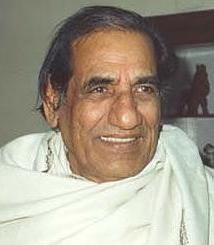
Sita Ram Goel was a lifelong critic of the RSS, but unlike Mukhia, he knew what he was talking about. Already as a student, he remarked that only mediocre fellow-students were going to shakhas whereas the brighter ones were concentrating on other pursuits or were seduced by Communism. Anyone who has read some of his work (but that is where the problem for Mukhia arises) has seen for himself that its message is quite different from the RSS line.

Mukhia continues: “In the shakhas, they do tell you that Aurangzeb demolished temples and erected mosques in lieu of them (which he did at Mathura and Varanasi), but they never tell you that he was also giving monetary and land grants to other Hindu temples, including some in Varanasi itself, the original document for which is on display at the Bharat Kala Bhavan on BHU campus. Historians KK Datta and Jnana Prakash have also published numerous documents of Aurangzeb giving such grants to temples, maths and other Hindu institutions, and many more remain unpublished. Naturally ‘historians’ like Goel and Elst wouldn’t know of them, nor would care to know.”

It is not only in the shakhas that they tell you this. Aurangzeb himself gave orders for a general destruction of temples and literally demolished thousands of them. Many other Muslim rulers acted likewise. No amount of special pleading by the eminent historians can change Islam’s record in this regard. It is possible that earlier, Aurangzeb gave some grants to Hindu institutions, as had been the Moghul dynasty’s policy since Akbar. We should of course not take Mukhia’s word for it (the eminent historians have a well-established reputation for mendaciousness), and “numerous” is certainly an exaggeration, but it remains possible. This only shows the inertia of changing a policy, as well as Aurangzeb’s increase in devotion to Islam, from a compromise-prone successor of Akbar to a zealous activist for Islam, which does not tolerate idolatry.

One issue where the much-maligned RSS is clearly wrong in its assessment of Aurangzeb, is its condemnation of him as a fanatic person. The said grants to temples, if true, may further prove a point that I have had to make repeatedly: it is not true that Aurangzeb was a cruel character, he was not more so than his less notorious predecessors. If he was cruel and fatatic, it was because he started taking the core doctrine of Islam to his heart. He was a pious person, more than is good for a ruler, so he became increasingly averse to the religious compromise on which his great-grandfather Akbar had built the Moghul empire. So at some point in his advancing years, not his personal predilection but his growing commitment to Islam took over. That is when he ordered all Pagan temples destroyed: when the Moghul empire became truly Islamic at last. But the RSS is fearful to say this, so it tells itself and its listeners that Islam is okay but that Aurangzeb “misunderstood” his religion due to his cruel and fanatic personality.

The professor has some advice for my friend: “If you really want to study history look at the works of professional historians — Tara Chand, RP Tripathi, Mohd. Habib, ABM Habibullah, Satish Chandra, Irfan Habib, RM Eaton, Cynthia Talbot and many other stalwarts who gave their life time to studying medieval history from the original Persian sources, not from third rate and motivated translations like History of India as Told by its Own Historians. Motivated? Sir Henry Elliott, who compiled this 8-volume series, wrote in his Preface: The series is being compiled ‘to let the bombastic babus of India know how terrible Indians’ life was until the British came to their rescue’!! So, Sir Elliott translated only those passages from the Persian language chronicles of medieval India which spoke of Muslims’ atrocities on the Hindus!! He will tell you that Aurangzeb demolished temples, but not that he also patronised them!!! Much like the RSS does now and chaps like Goel and Elst follow in their footsteps.”

See, the eminent historians are as good at the use of exclamation marks as your average Hindutva internet warrior. And yes, Elliott was guilty of espousing the same theory which the eminent historians have been spreading, viz. that the British took India from the Moghuls, omitting the successful Hindu effort to liberate most of India from Muslim occupation and then succumbing to the British. But that doesn’t make his translations wrong. He selected those parts which would be most telling for the atrocities undergone by the Hindus under Muslim rule so that they would appreciate British rule by contrast – and then translated these faithfully. He reminded his Hindu readers that their “own historians” (meaning India-based Muslim chroniclers) had reported these Islamic atrocities. Anyway, I would like to see the secular improvement, e.g. how do you translate the frequently-used Arabic verb q-t-l, Persian kushtan, both meaning “kill”. There aren’t too many nuances to that, are there?

Elliott’s translations were correct, but yes, they were selective. Secularists would have preferred to plough through an 88-volume rather than an 8-volume translation. But they are at liberty to go through all the untranslated parts and try to find a refutation there of what was described so explicitly in the translated parts. The Muslim chroniclers were in no mind to undo all the destruction they had evoked, so in the less dramatic parts of their work, they explored more leisurely subjects but refrained from trying their hand at what the secularists would like to read there, viz. any refutation of the grim picture they had first painted, and which Elliott and others have ably translated.

For lack of facts, Prof. Mukhia likes to throw names around instead. But a real historian remains unimpressed by this show of name-dropping. The fact that Prof. Mukhia has many like-minded colleagues in academe while his opponents have to remain on the outside is not the result of better competence among his friends, but of a deliberate policy in university nominations. Any young historian who lets on too early that he has pro-Hindu convictions, will see his entry into academe barred. Word will spread around that this man is “dangerous to India’s secular fabric” and he will be excluded. There have been some old historians who entered the profession before their cards were on the table and who only became forthright critics of Islam at the end of their careers, the likes of Prof. Harsh Narain and Prof. K.S. Lal, both since long deceased. Today among university historians, the school that sets the record on Islam straight is simply non-existent.

Fortunately, the political equation that makes the present secular-Islamic bias possible, is bound to come to an end one day. The elderly Prof. Mukhia won’t live to see that revolution anymore, but it is sure to happen. The truth which the eminent historians have long suppressed, will shine in the open. On that day, I wouldn’t like  to be called Harbans Mukhia.

The professor concludes: “I know this would have no effect on you. But just by chance if you can pick up enough courage to study history on your own and not parrot the history taught in the shakhas. Best wishes, Harbans Mukhia”

It seems Harbans Mukhia mistook his correspondent for some fanatic Hindutvavadi, the kind who remains impervious to facts. Not that I know many such cases, for even the most extreme ones I’ve met remain true to a central fact that really occurred, viz. Islamic atrocities against Hindus. Some of them have personally lived through the Islamic carnage at the time of Partition or during the Bangladesh liberation war, massacres which completely dwarfed all Indian religious riots put together (including the largest of them all, the killing of three thousand Sikhs by Congress secularists in 1984). But this correspondent is a successful cyberprofessional in Silicon Valley, who has made a more sophisticated study of just what it was that Islam wrought in India.

The greatest insult which the eminent historians could fling at Sita Ram Goel or myself is that we are “parroting history taught in the shakhas”. First off, I don’t even know what history they teach there. I have visited a few shakhas and can’t remember any history being taught there. I speculate it is streamlined to fit the Hindu and nationalist narrative, or at least that Mukhia wants to convey that impression. So be it, but historians have other sources for their history-writing and are not parrots of a party or movement. The main exception are the Indian secularists, whose conclusions are invariably those desired and taught by the Nehruvian rulers.

A second mail by the professor starts out by ridiculing the RSS concept of history: “First, the RSS rant started in the 1960s with the figure of 300 temples destroyed by the Muslim rulers; then in the 70s another 0 was added. Yet another got added in the 80s. But by the 90s the Sangh Parivar ran out of 0s, so they adopted another arithmetical formula of multiplying by 2 and the figure now stood at a respectable 60,000.”

 This claim may be true or not, but I am not privy to RSS historiography. As a matter of fact, 60,000 may just happen to be a good number, for the documented cases of temple destruction (and they already run into the thousands) are necessarily only a fraction of the more everyday cases, which must have been even more numerous. But we as historians can only deal with documented cases, especially since these are difficult enough. Indeed, of the ca. 2,000 cases listed by Sita Ram Goel, and more than 20 years after having been out in the open, not one has been refuted by Prof. Mukhia and his school.

So, like most secularists, he goes hiding behind an American self-described Marxist, Prof. Richard Eaton: “RM Eaton, who would necessarily be suspect in your eyes because he is a an American historian, examined the number of temples destroyed in the whole expanse of medieval India from 1200 to 1760 and came to the figure of 80. He has located the exact source of information or each demolition and put all the information in a tabular form. His brilliant article is called ‘Temple Desecration in Medieval India’. By the way, Eaton is aware of the figure of 60,000 handed out to credulous people like Sita Ram Goel, Koenraad Elst and yourself.”

In several respects, Eaton’s count is incomplete. Muslims destroyed Hindu temples before 1200 and after 1760 too, witness the near-absence of the once-numerous Hindu temples in Pakistan, witness the regular occurrence of temple destruction in Bangla Desh. It is also seriously false that for this period, Eaton’s count is complete. How could it be? Off-hand, Venkat could name a few cases from his own Tamil village, which was only briefly touched by the Islamic invasions but nonetheless already lost several temples, and they don’t figure in Eaton’s list. Archeologists regularly find remains of destroyed temples, often underneath mosques, which do not and cannot figure in Eaton’s list. Finally, one item on Eaton’s list doesn’t mean one temple destroyed. The thousand temples destroyed in Varanasi during Mohammed Ghori’s advances ca. 1194 form only one item on his list. What Mukhia calls “eighty” is in fact thousands of temple demolitions. So in spite of his Islam-friendly intentions, Eaton has only proven what Hindus have been saying all along: Islam has destroyed thousands of temples.

I had in fact answered Eaton’s list and explanation when they were published: “Vandalism sanctified by scripture”, Outlook India, 31 Aug. 2001 ( http://www.outlookindia.com/article.aspx?213030). Needless to say, my arguments have never been refuted by anyone. Secular historians are so sure about controlling the information flow through education and the media that they don’t bother to interfere when their falsehoods are exposed. In the article, I also mention Eaton’s sidekick Yoginder Sikand, then a furious Hindu-hater and secularist journalist. But in the meantime, he has recanted and exposed the whole self-serving buffoonery that does by the name secularism: “Why I Gave Up On ‘Social Activism’”, Countercurrents.org, 19 April, 2012: (http://www.countercurrents.org/sikand190412.htm).

Prof. Mukhia goes on: “Incidentally, Hindu temples were also demolished by Hindu rulers long before Muslims came to India. King Harsha of Kashmir had appointed an officer, devopatananayaka (officerin-charge of uprooting of gods) as reported by Kalhana’s Rajatarangini and mosques were also destroyed by the Hindu rulers in medieval India. Details of it can be found in my book, The Mughals of India. Incidentally, I have never been funded by any US agency, University or institution and all my education has been in India, and all schooling in Hindi medium. This is just to guard you against the stupidity of levying charges such as you have done against the most outstanding Indian historian of our time, Romila Thapar.”

As for Harsha, chronicler Kalhana says: “Prompted by the Turks in his employ, he behaved like a Turk.” It is simply not true that his case exemplifies a Hindu type of iconoclasm. On the contrary, he merely shows the influence of Islamic iconoclasm. Half-literate secularists keep on repeating this story a decade after it has been refuted in my paper “Harsha of Kashmir, a Hindu iconoclast?”, ch.4 of my book Ayodhya: the Case against the Temple (Delhi 2002; http://www.scribd.com/doc/10022510/Ayodhya-3-Books-by-Koenraad-Elst).

It should be granted to Prof. Harbans Mukhia, as to his colleague Prof. Irfan Habib, that they have faithfully followed the old Nehruvian line of distrusting the “foreign hand”, particularly the Americans. This is very unlike their colleague Prof. Romila Thapar, who has been lavishly sponsored in Washington DC. And among their generation, this was still exceptional. Indian secularists were admired from afar, followed by the leading American scholars of India, like Prof. Paul Brass or Prof. Robert Frykenberg, but keeping their distance because of the reigning anti-Americanism. Now however, Indian academics of the right persuasion are openly courted and hosted by American colleagues.

 Returning to the subject-matter, the professor asks: “But the question is more complex: how is it that Aurangzeb, an orthodox Muslim on RSS account, waited for 21 years after coming to the throne to reimpose the jazia? You remember the date of its abolition by Akbar but not one of its reimposition which is 1679. How did he keep his religious zeal in check for 21 long years when he was the undisputed sovereign of India? And why was he giving grants to temples while he was keen on demolishing it? The questions is WHY?”

“The answer is that huge and complex empires are not governed by religious zeal of its rulers but by an enormously complex interaction of political, administrative, cultural, social and religious considerations. Remember Rajiv Gandhi passing a Bill in Parliament after the Shah Bano judgment of the Supreme Court and getting the doors to the Ram Janmabhoomi-Babri Masjid disputed site opened almost simultaneously? Was he being a zealous Muslim or a zealous Hindu or just a clever political manipulator?”

Strictly speaking, not the Government but the Court opened the locks of the Ayodhya building. But it stands to reason that the two played together, and that the Court executed the policy desired by the Government. At any rate, yes, Rajiv Gandhi was a clever manipulator, zealous only in furthering his personal power and wealth. He intended to solve the communal situation bloodlessly by handing the Hindus full control of Ayodhya (including the right to rebuild a temple instead of the Babri Masjid) and giving the Muslims other goodies, such as a Sharia-inspired change in the law  on Muslim divorce or the ban on Salman Rushdie’s book The Satanic Verses. This not-so-principled but very practical policy, typical of the “Congress culture”, would have succeeded but for the intervention of the eminent historians and like-minded intellectuals: they raised the stakes on Ayodhya and the Babri Masjid (“the bulwark of India’s secular polity”, etc.) so much that the Government could no longer pursue its pragmatic give-and-take plan. The result was endless religious riots, the surreptitious demolition, and more riots culminating in the Muslim bomb attacks on Mumbai of 12 March 1993, which pioneered a new Muslim tactic repeated in many other bomb attacks including those on the US of 11 September 2001. The eminent historians have blod on their hands.

It is also true that the Moghul empire was based on a religious compromise, that Aurangzeb’s conversion to a more principled Islamic policy jeopardized this compromise, and thereby endangered the empire itself. At the end of his life, amid Hindu rebellions, Aurangzeb understood this well enough. But he was too much of a pious Muslim to turn the clock back.

“As for Sita Ram Goel — he used to rant regularly in the Indian Express about the little that RSS had taught him of history: Islam teaches you intolerance, every Muslim ruler was inspired by Islam to destroy Hindu temples and Hindu society etc. etc. and how Marxist historians cannot face up to the truth of all his rants. You obviously read all this avidly. You obviously did not read ‘Reflections of the Past’ in the same paper dated 30.4.1989 by a non-descript historian called Harbans Mukhia. Since that date, Sita Ram Goel did not write a thing at least in the Indian Express. Please check it out; it should be available on the IE website. If not, you will find it in the same non-descript historian’s book Issues in Indian History, Politics and Society, pp. 31-34. Please forgive me for advertising my own writings; I avoided reference to myself in my earlier response, but since you were out to challenge us secular historians, I felt compelled to reverse my earlier decision. In any case you wouldn’t have heard of many historians anyway; the RSS never lets you know that they exist.”

Well, I didn’t know about this episode. 1989 is the year when I first met Sita Ram Goel, at the end of the year. Arun Shourie was then the editor of Indian Express, and in that capacity, he published a number of articles that went against the secularist opinion. In his books on religion and communalism, he made use of insight he had learned from Goel. It is very much news to me, and does indeed sound highly unlikely, that Shourie would have censored Goel. And it sounds completely ridiculous to assume that Goel laid his pen aside because of what an eminent historian wrote. For the next 14 years, Goel keept on writing forcefully against all anti-Hindu forces including those represented by Mukhia.

As a parting-shot, the eminent historian informs us a bit more about his locus standi regarding translations: “By the way, the translations of the medieval Indian Persian texts are quite often atrocious. I happen to know because my doctorate at Delhi University back in 1969 was an evaluation of these texts. It is called Historians and Historiography During the Reign of Akbar.”

As already said, “killing” is something that happened frequently when Muslims encountered Hindus, and the Muslim chroniclers thus had to describe this process quite often. Harbans Mukhia has not convinced us that under the hands of the translators, “killing” only got mentioned as a mistranslation of, say, “tolerating”. Maybe the more abstruse elements in the narrative were subject to mistranslation, but the relation between Hindus and Muslims was pretty straightforward and hard to mistake for friendship.

The august professor bids us goodbye: “Voila, this is my last intervention in this so-called debate. I have better things to do than rectifying the RSS version of history. Best wishes, Harbans Mukhia”. Amen to that.


(5951)

A Nazi Out-of-India Theory?

[box_light]While we were working on the argumentation against the Aryan Invasion Theory (AIT), an improper and utterly false argument against the presumed association of the rivaling Out-of-India Theory (OIT) with Nazi Germany was being prepared in high places. This becomes clear from a refutation of the latter in a paper published by the International Journal of Hindu Studies (no.16 = 2012, p.189-252), and written by the German scholar Reinhold Grünendahl (Göttingen): “History in the making: on Sheldon Pollock’s ‘NS Indology’ and Vishwa Adluri’s ‘Pride and prejudice’”.[/box_light]

The homeland debate

Ultimately, a question of ancient history, such as the location of the homeland of the Indo-European language family inside or outside of India, will not be decided by its real or putative association with political tendencies in the modern age. Thus, when Hindus are writing for the umpteenth time that the AIT stems from colonialism and racism, they may be wrong or they may be right, but at any rate they are wasting their breath. Historians know that even a theory generate History plays out in a time when other concerns were at stake than in the present  by the wrong motives may prove to be right, and even a point of view stemming from noble political positions may be wrong. We all would like to domesticate history into political usefulness for today, but have to acknowledge that it doesn’t work that way.

All the same, the AIT school do occasionally try to blacken the Hindu nationalist movement’s new found enthusiasm for the OIT with a wrong political association, viz. by fitting it into their well-established narrative that somehow this is a “fascist” movement. Thus, in a newspaper column, Robert Zydenbos (“An obscurantist argument”, Indian Express, 12-12-1993) tried to associate Navaratna Rajaram’s arguments for the OIT with Adolf Hitler’s National-Socialism. More crassly, Yoginder Sikand (“Exploding the Aryan myth”, Observer of Business and Politics, 30-10-1993) likewise tried to link the OIT with Nazi Germany, playing on their common concern for (but diametrically opposite interpretation of) the term Arya.

Of course, nobody who follows the debate, closely or even from afar, can be taken in by this. Very obviously, the Nazis themselves never believed in the OIT but were more ardent than most in espousing the AIT. Practically all Westerners at the time, and many Indians as well (including the Hindu nationalist leader of Congress, Balagangadhara Tilak, and the ideologue of the Hindutva movement, Vinayak Damodar Savarkar), took the AIT for granted. The Nazis had an extra reason for putting their faith in it, viz. that the AIT served as the perfect illustration to the Nazi worldview. The Aryan immigrants had demonstrated their superiority, they had sought to protect it by instituting a colour-based (to the Nazis: race-based) caste system, and they had lost part of their European quality by succumbing to race-mixing nonetheless. So, if anyone should be likened to Hitler, it is the AIT advocates themselves, including Zydenbos and Sikand. The OIT school rarely misses a chance to highlight this political identification of the AIT: with British imperialism as well as with European racism epitomized by the Nazis.

We may assume that Zydenbos was a newcomer to this debate, that he objected to the OIT in good faith and that he hadn’t informed himself of the Nazi view on the homeland question. But two decades down the line, the AIT belief has definitely lost its innocence. And already back then, a specialist like Columbia professor Sheldon Pollock published a paper titled: “Deep Orientalism? Notes on Sanskrit and power beyond the Raj” (in Carol A. Breckenridge and Peter van der Veer, eds.: Orientalism and the Postcolonial Predicament: Perspectives on South Asia, UPenn Press 1993, p.76-133), which includes a chapter titled “Ex Oriente Nox: Indology in the Total State” (p.86-96). He and his acolytes have since kept on elaborating this thesis, viz. that Germany invested much in Indology and used it in its project of self-definition as “Aryans” contrasting with the “Semites”. A recent example of this polemic is Vishwa Adluri’s paper in Pollock’s defence, “Pride and prejudice: Orientalism and German Indology” (International Journal of Hindu Studies, 15 (=2011), p.253-294).

While we, both in the OIT and AIT camp, were concentrating on the scientific evidence pertaining to the homeland and to the direction of the Indo-European expansion, someone somewhere was working on a large-scale and truly daring attempt to finally link the OIT to the National-Socialist regime. Nonetheless, a Hindu industrialist recently donated Pollock a fabulous sum of money for his work on Sanskrit literature, trusting him more with this heritage than other Indologists including the native scholars, both traditional and university-trained, who are far better at home in Sanskrit and financially far cheaper than an American academic. So, this highly reputed Sanskrit specialist sharpened his long-standing hatred of the Hindu nationalist movement into a paper alleging that Indology in general and the OIT in particular was much beloved of the Nazi establishment.

Edward Said

In this paper, Pollock at first seeks to supplement Edward Said’s unjustly famous thesis Orientalism (1978) with the German chapter which Said purposely left out. If truthful, such a chapter would have refuted Said’s whole theory, viz. that “Orientalism” was nothing but the intellectual chapter of the political-economic colonial entreprise. The mainstay of “Orientalist” scholarship was Central Europe, then thoroughly German-speaking at least at the intellectual level. Prussia only had colonies at a late date and far from the lands that interested the Orientalists, while the other countries involved, including the Austro-Hungarian empire, had no colonies at all. In the colonial countries too, many Orientalists were by no means part of the colonial entreprise (pace Said’s conspiracy theory), but in the German-speaking world, there was not even a colonial entreprise to integrate the Orientalist endeavour in; yet Orientalism flourished there like nowhere else. Moreover, Orientalism took wing when the Austro-Hungarian Empire’s Oriental neighbor, the Ottoman Empire, was by no means a colony but a threat and an equal trading-partner.

Indeed, even in its better-developed “British” part, Said’s theory was deeply flawed from the beginning, and the numerous errors of detail as well as the general error of his theory  have ably been pointed out by Robert Irwin (For Lust of Knowing: the Orientalists and Their Enemies, Allan Lane, London 2006) and Ibn Warraq (Defending the West. A Critique of Edward Said’s Orientalism, Prometheus, Amherst NY, 2007). A comprehensive work on German-language Oriental scholarship has been produced by Suzanne Marchand (German Orientalism in the Age of Empire. Religion, Race and Scholarship, German Historical Institute, Washington DC, and Cambridge University Press, 2009). With the benefit of hindsight, we can now pass judgment on Said’s influential publication which has seriously damaged the fair name of the academic discipline called “Orientalism”.

Academics who still rely on Said’s thesis, actually rely on a profoundly mistaken and highly politicized piece of scholarship. His thesis is a thin attempt at justification for anti-Westernism. Much as this is in vogue among Hindus, they are only making fools of themselves by espousing Said’s conspiracy theory. For everyone, it is  academically weak and factually full of mistakes, but for Muslims at least, they would be supporting their own man. They would be cheering for a Dhimmi, someone upholding Islamic causes, in that as well as in other books. In supporting Said, Pollock is true to his own camp, i.e. the anti-Hindu coalition. But for Hindus, there is nothing in it, they are cheering for someone serving a declared enemy.

What Nazi rule really meant for Orientalism

Grünendahl cites  many examples where Pollock and his defender Adluri manipulate quotations to make past authors witnesses for their accusations. I vaguely knew that Pollock was wrong in associating the OIT with National-Socialism, but not that he was so spectacularly wrong. His thesis is first of all that India was a central concern for the Nazis. This is put forward most emphatically (but only with bluff) by Pollock and, on his authority, generally taken for granted. Adluri elaborates that Germany was very worried about building its “identity” as contrasting with the Semitic heritage and the Semitic people in their midst, and used India for that purpose.

But Grünendahl shows from old and neutral sources that the Indology departments received no special attention, that they were small compared to Ancient Near-Eastern Studies, Sinology etc., and that the Nazi period showed no special interest in Orientalism in general or Indology in particular. If anything, they suffered in their orientation on India from the reigning emphasis on “Indo-Germanic studies”.

Marchand notes that the number of German Oriental scholars as a whole fell from 360 in 1931 to 180 in 1940. [2009:488] What connection she cites between Indology and the Nazis [2009:499] is wholly based on Pollock, who estimates that one-third of the (only!) ca. twenty-five Indology professors in the Third Reich were active in the National-Socialist party or in the SS. This is the only time she cites him in her 526-page book. (She also naïvely gives credence to other anti-Hindu scholars such as Reza Pirbhai, p.311.) According to her: “Worst of all among the Indologist collaborators was Walter Wüst, the Vedic specialist at the University of Munich who became the director of the SS Ahnenerbe.” [p.499] But Wüst is not known to have championed the OIT, on the contrary. The Nazi regime’s favourite historian H.K.F. Günther believed the homeland lay in Southeastern Europe. This was the reigning opinion in Europe, challenged only by some Nazis who insisted on Germany or Scandinavia as the homeland. All of them agreed that the Indo-European language family had only reached India through an Aryan invasion.

Let us add that Marchand agrees to include among the Nazi Indologists Paul Thieme, the revered teacher of Michael Witzel; and he was, like his more militant pupil, a believer in the AIT. According to Marchand, one of the Nazi concerns in Oriental scholarship was “the refutation of the Jewish origins of monotheism” (p.489) namely in Mazdeism. The picture of religion in National-Socialism was complex and diverse, but belief in the superiority of monotheism was unchallenged. Like racism, it was then part of the general consensus.

She also notes that: “Among the Islamicists, there were also numerous collaborators (…)  things looked rather promising for this bunch  in the period 1936-39” when the Nazi leaders Joseph Goebbels and Baldur von Schirach toured the Middle East, and the Islamologists were used to liaise with Muslim leaders like the Jerusalem Mufti, so that they “successfully disseminated Nazi ideas throughout the Middle East”. [2009:490] Wouldn’t that be a good topic for Orientalist scholars: Islamic-Nazi similarities as the reason for Nazi-Muslim friendships?

The Nazi concern for “Aryans” speaking “Indo-Germanic” (innocently so named after its two extremes: Indo-Aryan in Bengal and Germanic in Iceland) or Indo-European, now and originally conceived as a language family but then also conceived as a racial unit, couldn’t seriously be bothered with India.  Their main concern was with the North, so Grünendahl argues:

“The fundamental flaw of Pollock’s narrative is that it hinges entirely on the exact reverse of the ‘Nordic’ notion. This reversal, which provides the basis for the ‘founding myth’ of the entire discourse machinery he set in motion, is enshrined in the grotesque proposition that ‘the Germans… continued, however subliminally, to hold the nineteenth-century conviction that the origin of European civilization was to be found in India  (or at least that India constituted a genetically related sibling)’ (1993:77) Even to the Romantic period [end of 18th, early 19th century, when this notion was upheld by Johann Herder], this assertion only holds with considerable qualifications (…) To make it the basis for theorizing any aspect of the NS period is rendered absurd by the above-mentioned texts alone”. [p.199]

Hitler on the Hindus

Reference is to texts revealing Hitler’s position on the Hindus. In 1920 already, he laid his cards on the table, and would never waver from this position, not in Mein Kampf, which disparages Hindus as also German neo-Pagans, not in his speeches nor in his wartime table talks. There he had evolved to mocking religion in general and his native Catholicism specifically, though he appreciated its organization and mass psychology and its anti-caste way of recruiting its priests from the people rather than from a separate priestly caste (yes, Hitler was also a comrade-at-arms of Pollock in their common anti-Brahminism). He only knew of the Hindus through the lens of the AIT:

“While Hitler does refer to ‘the Hindus’, he does so not with the intent to employ them as distant relatives in the ‘creation of Indo-German as counter-identity’ (Pollock 1993:83), but merely as an illustration of ‘racial decline’ (Rassensenkung) due to the destruction of ‘national purity’ (nationale Reinheit.)” (p.218, with reference to Adolf Hitler 1980 (1920): “Warum sind wir Antisemiten?” in Eberhard Jäckel and Axel Kuhn, eds: Hitlers sämtliche Aufzeichnungen, 1905-1924, p.184-204: specifically p.195-196)

So, Hitler’s rare utterance on the Hindus was a racial interpretation of the AIT. These are his own words (1980/1920:195): “Wir wissen, dass die Hindu in Indien ein Volk sind, gemischt aus den hochstehenden arischen Einwanderern und der dunkelschwarzen Urbevölkerung, und dass dieses Volk heute die folgen trägt; denn es ist auch das Sklavenvolk einer Rasse, die uns in vielen Punkten nahezu als zweite Judenheit erscheinen darf.” (“We know  that the Hindus in India are a people mixed from the lofty Aryan immigrants and the dark-black aboriginal population, and that this people is bearing the consequences today; for it is also the slave people of a race that almost seems like a second Jewry.”)

For Grünendahl, this is merely an example of how the primary sources of German history contradict the free-for-all that amateur historians make of it, in this case the manipulated narrative by Sheldon Pollock. He sounds like defending Germany’s true history against American (and then, by imitation, Indian) distortions. Probably he doesn’t realize that this distortion, about the presumed Nazi love for the OIT, constitutes Pollock’s ultimate motive. We don’t want to pretend to read inside a man’s skull, so we will not speak out on his intimate motives. But the objective finality of his thesis is at any rate to blacken the OIT by associating it with National-Socialism. Reality, however, is just the opposite: more even than other Europeans, the Nazis espoused and upheld the AIT. Hitler-Pollock, same struggle!


(4408)

Colour Prejudice in India : A History

[box_light]In India the preference for lighter skin is well known. In Bollywood lighter actresses such as Katrina Kaif find that the right skin tone outweighs talent and ignorance of Hindi. Skin lightening products do roaring trade. But what lies at the root of all this? Many people assume it is because over three thousand years ago India was invaded by lighter skinned Indo-European speakers known as Aryans. But this idea was actually manufactured by German Indologist Max Muller in order to justify British rule.

As Marx said if Indian history was merely that of a series of invasions, then the question was not if foreigners would rule India, merely which set of invaders imposing their rule. Muller later retracted his thesis saying that by ‘Aryan’ he meant language and not race. But by then the damage had been done and to this day the idea remains regretfully mainstream and is rarely challenged unlike the Hamitic Invasion Theory of Africa which dates to around the same period but has now been dropped for the racist idea it was.[/box_light]

When ‘Brother-in-Law’ means Rape

If we cannot blame the aforementioned non-existent ‘Aryans’ then could it be due to two centuries of British colonialism? Certainly this favoured lighter skin and there was even a mixed race of Anglo-Indians deliberately created as a buffer between the Raj and the masses. But anyone familiar with Indic languages knows that the preference for lighter skin just seems too deep. For example in Punjabi the phrase “kali mu vaaliya” (one with black face) has extremely derogatory connotations. No, we must look at other clues in this search.

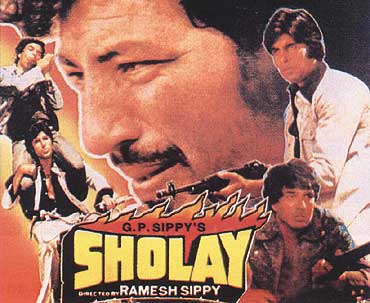
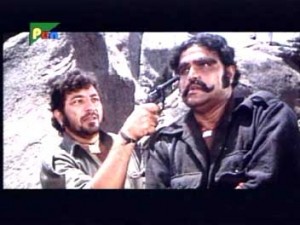
Released in 1975 Sholay remains among the greatest films of Hindi cinema. One cinema in Mumbai ran the movie for 286 weeks straight (more than five years). Dubbed a ‘curry western’ Sholay achieved a still-standing record of 60 golden jubilees (50 consecutive weeks) across India and may well have been the highest grossing film ever produced by Bollywood. Now it is the famous scene of Russian roulette we are concerned with here. Leading a band of dacoits, Gabbar Singh (played by Amjad Khan) puts a pistol to the head of three of his men who are sent back empty handed from the village of Ramgarh.

Putting the gun to the head of his first subject Gabbar pulls the trigger only to find the chamber empty. He utters the now immortal words “bach gaya saala” in his menacing voice.

This is usually translated into English as “the bastard survived”.

But in Hindi and Punjabi the word ‘saala’ does not mean ‘bastard’. It means ‘brother-in-law’. So how to explain this? Using the exact translation would not make sense. But in the cultural and linguistic context it makes perfect sense.

The term ‘saala’ can be one of family endearment.But in this and many other contexts is means something very specific, namely ‘I slept with your sister’. This also implies ‘you can now take her back’.

In his 1992 book Negationism in Indian History, Belgian scholar Koenraad Elst mentions this:

“It is because of Hanifite law that many Muslim rulers in India considered themselves exempted from the duty to continue the genocide on the Hindus (self-exemption for which they were persistently reprimanded by their mullahs)….. The Moghul dynasty (from 1526 onwards) in effect limited its ambition to enjoying the zimma system, similar to the treatment of Jews and Christians in the Ottoman empire. Muslim violence would thenceforth be limited to some slave-taking, crushing the numerous rebellions, destruction of temples and killing or humiliation of Brahmins, and occasional acts of terror by small bands of raiders. A left-over from this period is the North-Indian custom of celebrating weddings at midnight: this was a safety measure against the Islamic sport of bride-catching.”

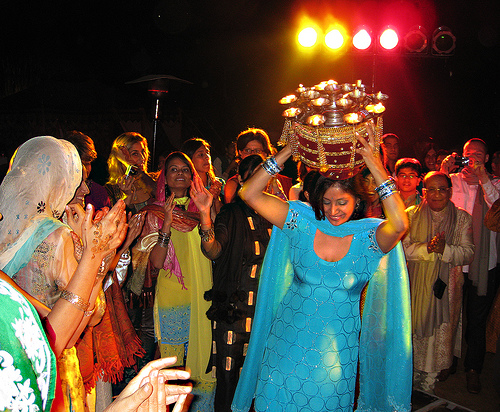
Jaago, meaning “wake up” a marriage folk dance in the Punjab, taking place at night where girls dance through the village streets carrying a pot (gaggar) decorated with lightened candles and singing jaagu songs.

It is the last sentence that should interest us because it explains why ‘saala’ is such an abusive term. In fact it is merely the tip of a massive politically incorrect and rarely explored iceberg.

The Blackness of Servitude in India

In his 1994 book The Muslim Slave System in Medieval India,  KS Lal has detailed how right from the invasion of Muhammad bin Qassim in the seventh century Hindus were subject to enslavement as an integral part of Islamic conquest, rule and forcible conversion. Females were especially targeted to fill the harems of sultans and their nobles. As mentioned by Dr. Elst, this is the origin of Hindu marriages being celebrated at night. It also led to jauhar, the mass self-immolation by which Rajput women preserved their honour rather than be capture. This was done by lighting  a huge fire in a pit into which women and children then jumped in order to avoid rape and enslavement.

In more recent years similar desperate action was taken by Sikhs avoiding humiliation through rape and forcible conversion and marriage when Pakistan was formed. For example in the village Thoha Khalsa of Rawalpindi District in 1947 only three women survived because there was not enough water in the well to drown them as they sought to evade capture by Muslim marauders intent on exterminating the unbelievers in their midst.

What Pakistan perpetrated on its Hindu and Sikh inhabitants from its very inception was merely a replay of centuries of Islamic colonialism, genocide, demographic upheaval and cultural dislocation. It was something that was to burst with full fury in 1971 as East Pakistan fought to break free as the independent state of Bangladesh. The Pakistani military and ruling caste was from the west composed of mainly Punjabis and Pathans such as Ayub Khan who saw their darker-skinned Bengali eastern brethren as mere Hindu converts to Islam, while they were descendants of great conquerors such as the Mughals.

Indeed the Islamic conquests were constantly wracked by internal racial strife. Afghans, Arabs, Turks and Iranians occupied the higher echelons of government. Hindu converts and African slaves were considered as inferior. Lal:

“D.B. Davis in his Slavery and Human Progress attempts to estimate the number of blacks that would have been sold as slaves and imported into India. According to him “the importation of black slaves into Islamic lands from Spain to India constituted a continuous large-scale migration that in total numbers may well have surpassed, over a period of twelve centuries, the African diaspora to the New World”.

The absence of a large population of black survivors can be explained by their high mortality rate; by assimilation with other peoples; and by the fact that many male slaves had been castrated. Even so in central part of India and on the western coast, there are communities of blacks who are descendants of African slaves. On some Western Coast Islands also there live descendants of black slaves. The Jinjeera Island, so called because of mispronunciation by Marathas of Jazeera meaning island, or Zanzeera meaning land of Zanj or Blacks, is their main abode. It is also called Habsan or the land of Africans or Habshis. In the seventeenth century these islanders, called Sidis of Jinjeera, served as admirals of the Mughals and were at constant war with the Marathas.”


The writer continues:

“However, in contrast to the foreign imported slaves, whose market price was rendered high by cost of transportation and deaths in transit, the price of Hindu slaves, sold abroad remained low. For example, Hindu Kush (Hindu-killer) mountain is so named because thousands of enslaved Hindus died in crossing it. But their numbers were so large that the price of survivors remained low in foreign markets.”

( http://voiceofdharma.org/books/mssmi/ch10.htm )

The Mughals continued this export of  Hindu slaves to Iran and Central Asia. Jean-Baptiste Tavernier visited Mughal India during the reign of Shah Jahan in the seventeenth century. He made this observation on the ruling class:

“They were called Moguls, that is, white of complexion . . . the natives being all brown or olive colour.”

The physician François Bernier also noted the skin colour of the ruling elite:

“…to be considered a Mogol, it is enough is a foreigner have a white face and profess Mahometanism.”

The Mughals were in fact Chagatai Turks. But it was the Iranians who dominated the Muslim regime oppressing India’s toiling Hindu masses. The Iranians looked down upon the Mughals and Indians as barbarians and were helped in their superior status by a preference for lighter skin colour. Indeed Bernier said that as successive generations of Iranian immigrants became darker, they lost the respect accorded to newcomers and all fair-skinned Muslim immigrants as part of the ruling class. Italian traveller Niccolao Manucci said that Iranians constantly referred to Indians as “slaves” or “blacks”. Afghans, though part of the ruling class, were portrayed as crude and vulgar.

Racial and ethnic strife had existed from the very advent of Islam, between slaves and free, even between northern and southern Arabs. But the Arabs had always formed a hereditary ruling caste over the vanquished from the time of the Ummayads. Any Muslims who had Iranian, Berber, Aramaen or other undesirable blood was classified as Mawl? and excluded from the dominant racial caste. Strict social barriers were maintained between the Arab ruling racial caste and the non-Arab oppressed masses. Embracing Islam was no escape from this badge of inferiority. While Arabs could take wives from the indigenous people, the converse was not true. The non-Arabs resented their treatment as racially inferior.

For example, Mawálí soldiers were led by Arabs generals only on foot with their weaponry being limited to a baton. As a reward for defeating the Ummayad army outside Mosul was to have the Arabs massacre the 7000 mawálíinhabitants of Kufa. From the late seventh century, black slaves from East Africa were used in the marshland of Mesopotamia to cultivate cotton and sugar on plantations. Housed in very harsh conditions of camps of up to five thousand captives, they rebelled in 694 which was crushed. These were known as the Zanj. The Zanj rebellion resulted in extremely racist attitudes towards blacks, as expressed in Arabic literature, by poets of Ethiopian descent, known as the “black crows of the Arabs”, such as Suhaym (d. 660), Nusayb ibn Rabah (d. 726), and Abu Dulama (d. c.776), pointing to clear evidence that black slaves had the lowest position in Muslim society. Racism was in fact as central to Arab slavery as it was in the western system which developed later. Arabs saw their own olive pigmentation as preferable to lighter Greeks and Iranians as well as darker people of the Horn of Africa. Early Arabic poetry describes the many nuances of human coloration. In fact the name of the seventh century poet, Suhaym, literally means “little black man”, and he penned verses such as the following:

“Though I am a slave my soul is nobly free Though I am black of colour my character is white.”

Nusayb ibn Rabah responded to a racist attack on him by an Arab poet, because he was black:

“Blackness does not diminish me, as long as I Have this tongue and this stout heart.

Some are raised by means of their lineage; the Verses of my poems are my lineage!

How much better a keen-minded, clear-spoken Black than a mute white!”

By the fourteenth century, the Arabic word “abd” as used to mean black slave, while “mamluk” meant a white slave. Black Africa remained a major source of slaves for the Islamic world until well into the twentieth century. Blacks came to be seen as natural slaves when compared to other races. It was this prejudice against darker skin which was imported into India and has been entrenched their over the centuries. But the other legacy of Islamic slavery and racism was even worse.

Hindu Kush means Hindu Slaughter

The numbers of Hindus enslaved and exported from India by various Islamic invaders and imperialists was staggering, to such an extent that it gave the name to the mountains in Afghanistan as so many died en route. In Iran these Indian slaves were forced to work in the mines while slaves were also imported from Africa in huge numbers. In 1849 and 1850, Lady Mary Eleanor Sheil wrote from the British embassy that black slaves known as Nubees or Habshees were highly esteemed and well treated. However racial prejudice appears to have increased after slavery ended, as reported by Joseph Harris in 1967 in several cities. An Afro-Iranian community near Bandar Abbas complained of racism by other Iranians.

As well as colour prejudice towards darker skin in India and Iran, Islamic slavery had other negative influences which are only just being uncovered. In his 1979 book Roma: The Gypsy World, Dr. SS Shashi challenged the belief that Europe’s Gypsies had their origins in any of India’s “untouchable” castes. Instead he traced the Roma to various castes including Rajputs, Banjara, Jat, Ahir, Dhangar, Dom and Sansi. Iranians still refer to Gypsy groups of Indian descent as Luri. Arabs call them Zott while in Syria they are referred to as Nawar. Nineteenth century Dutch historian MJ Goeje wrote that the Arabs brought tens of thousands of Indian peasants from the Indus region as slaves to be settled in Iraq. These Zotts became powerful enough to challenge the Abbasid Khalifate and hence Baghdad sent its forces against them in 820. The Zotts were defeated in 834, and the entire population deported to Syria. South African born scholar and anti-apartheid activist Ronald Segal mentions this slave revolt by the Zotts or Djatts, which he said were Indian slaves deported from the Lower Indus to the swamps of Lower Mesopotamia, to breed water buffalo while living in extremely impoverished conditions, which led to their rebellion. He says that their defeat led to them being deported to various parts of the Abbasid caliphate. This may explain why Gypsy groups of obvious Indian descent remain in the region, continuing to be disclaimed by the Arabs, Iranians and Turks as being part of their respective communities. They  are known as the Domari.

Professor Ian Hancock from the University of Texas , scholar of Hungarian Roma and British Romanichal descent,  concludes that the Roma are therefore most likely the descendants of high-caste Hindu Rajputs and not the Doms. Romani vocabulary points to a one time settled rather than nomadic population. In India there are nomadic groups such as the Banjara which claim descent from Rajputs, and left their homeland of Rajputana after the defeat by Mahmud of Ghazni in the eleventh century. At the Second World Romani Congress in April 1978, Ranjit Naik stated that Rajputs had fled these invasions into Central Asia. Then in 1998, B Shyamala Devi Rathore submitted a paper at the Romani Studies conference at Greenwich University, in which she mentioned Banjara historians that wrote about Rajputs leaving their homeland of Rajasthan due to the Ghaznavid raids, and spreading out in all directions.

Hindu Rajput warriors were captured in warfare by the Ghaznavid Turks who invaded India during the eleventh century. From the Ghaznavids, the Seljuk Turks also took them as slaves. This Indian population then found themselves brought to Europe in the thirteenth century as slaves and also in military battalions by the invading Ottoman Turks. These were to become the Roma or Gypsies. Hancock in his 2002 book We are the Romani People:

“The first Romanies that the Europeans met were very different from any of the local populations – far more distinct than we are today. They were mostly dark-skinned, and wore unfamiliar clothing and spoke a language nobody recognised. They were neither Christian, nor Jewish, nor Muslim and seemed to have no country of their own. And most of all, they were extremely reluctant to let outsiders – the gadže – get too close.”

As the Turks conquered the Byzantine Empire and advanced into Europe, Roma were reduced to slave status. They were also enslaved by the landlords in Christian populations of the Balkans, especially Wallachia and Transylvania. Female Roma were subject to horrendous sexual exploitation right up until the abolition of Gypsy slavery after the creation of the modern state of Romania in 1864. It is unknown how this slavery began. Some may have already been slaves of the Ottoman Turks, or even the Tatars who had invaded Europe earlier. By the early 1300s, Roma in the Balkans were being included as property given as payment, even to monasteries. As non-indigenous people, as non-Muslims, and as slaves, Roma were at the bottom of the social scale in the Balkans, especially in that all conquered non-Muslims could be treated as property.

By the sixteenth century, the word for Gypsy in Romanian, tigan, had come to mean slave specifically of Roma origin. For this oppressed minority dislocated from their Indian homeland through distance and the centuries elapsed when their Hindu ancestors had been enslaved by the armies of Islam there was to be no happy ending. Half of the European Roma population died in the Holocaust in what is known in the Romani language as Porrajmos, a powerful world which translates as devouring or rape.

(13748)

The Huns : Barbarians Tamed by the Warriors of Dharma

[box_light]Myth says that when told of the power of the mighty Persian empire of antiquity, their ability to cover the very sun with their hail of arrows the Spartans would retort mockingly – ‘so much the better – at least we will fight in the shade’  The reality of war in the ancient world was of course quite different.[/box_light]

A thunderous hail of arrow and projectiles darken the sky. Waves of fast moving horse mounted warriors in compact bands of up to 4000 release their arrows before wheeling away to allow the next band to attack. In such a manner an unrelenting hail of projectiles would be hurled at the enemy. Modern historians have estimated that a mounted warrior of the early Common Era from Central Asia would be able to shoot at a speed reaching 40 kph. That speed combined with the range of the recurved composite bow when dealt with in massed attacks were an unmatched weapon until the introduction of the machine guns in the First World War. This was the Huns (also known as the Hunas )

Armed with this force the Huns swept across Asia bursting into the splendour of the Roman Empire destroy all before them. The hardy tribes of the Eastern Europe and the Balkans and around the Black Sea fell under a deluge of violence and havoc that the world has seldom seen. The mighty legions of Rome found their strongest armour and formations unable to withstand the legions of the Huns. The name of their leader, Attila has become a byword for terror and destruction which was scarcely held off in the depth of Western Europe at the Battle of the Catalaunian Fields.

However many centuries later the Huns had defeated and taken prisoner Feroz, the Persian Emperor and made them a subject peoples.Onwards the waves of destruction marched into South Asia only to meet with the might of the Gupta Empire in the noontide of their power. The vast dominions of the Guptas had been conquered by a succession of warrior emperors and was now led by Skanda Gupta. Marshalling his forces he marched to meet the as yet undefeated Huns under their leader Khingila and in a ferocious conflict near the borders of modern India

The warriors of Skanda Gupta braved the waves of arrows and barbaric onslaughts of the Huns to engage them in a deadly hand to hand combat. The military skill of Skanda Gupta enabled him to marshal his reserves and thwart each probing attack of the Huns and cut their supply lines to eventually inflict an unprecedented defeat –. The slaughter was so great that only a few wandering bands of the Huns returned to their cantons with a rumour of the wrath and terror of the Gupta Emperor.The Bhitari pillar inscription speaks of the great victory over the Huns and the court bards went on to say:

‘By whose two arms the earth was shaken when he joined in close conflict with the Huns’

Thus a great catastrophe was averted and whilst much of Europe was laid to waste India breathed a sigh of relief.The subsequent breakup of the Empire of the Gutpas after the death of Skanda Gupta however gave a new fillip to the Huns.

Their war leader Toramana united the Hunnic tribes and seeing the divisions amongst the kings of South Asia launched his mobile warriors into a renewed attack. This time the merciless hordes managed to break through the borders and establish a foothold. The land of Punjab was laid waste and left to the tender mercies of the Huns. The ancient university and seat of learning at Taxishila near modern Sialkot in Pakistan was utterly destroyed.  

Toramana launched further expeditions into the hinterland of India casing great devastation and horror. His and much of the Huns gradual absorption and acceptance of Indic and Vedic concepts did little to lessen the cruel and barbaric basis of Hunnic society

His son Mihirkula outdid his father in every concept. An early adept of Buddhism he later turned against the institution of the monks and despite becoming a votary of Vedic deity Shiva launched into a tirade of destruction against the Buddhist monasteries and the monks.

His overall cruel and despotic nature caused waves of revulsion across the land. The Yaudheyes raised a banner of rebellion in Punjab and from the land of Malwa the warrior king Yashodarman together with the last Gupta king Narasimnagupta in 528 CE gave battle to their ruthless enemies. Led by repeated charges by Yashodorman the Huns gave way and found their banners trampled into the ground by the Hindu kings the proud warriors who had carried death and destruction across the face of the known world were beaten into submission. Mihirkula was dragged in chains before the Hindu monarch and in an unbelievable act of chivalry was released unharmed to return to his dominions beaten and humiliated.  Temples were raised in honour of the Vedic Gods and of the sublime Lord Buddha to celebrate the victories over the Huns and their violations of the eternal laws of Dharma

Mihirkula returned chastised to his dominions and the Hunnic Empire collapsed into oblivion. The wheels of Dharma turned on as from the beginning of time – the Huns passed on into the annals of history but the people did not. The various cantons and mandalas of the Hunas merged into a revitalised Hindu society to stand at the forefront of Hindu society in the centuries to come together with the clans of the Rajput’s, Gujars, Jats, Nayars and others in a new spirit of honour and  chivalry that has seldom been seen in the world,


(13110)