Hate mongers
 Hate mongers often need concocted stories to buttress their political message. In India, these are most common in that peculiar Indian form of hatred: anti-Brahminism.
As the local counterpart to what anti-Semitism has been in the West, it fantasizes about how Brahmins have only domination over us lesser mortals as their uppermost concern. Everything a Brahmin does, just has to be a wily stratagem to manipulate others.
With their greater book-orientedness and heavy over-representation in the writing professions, they control public discourse and make others look at the world through Brahminical glasses. No matter how you try to gain autonomy, they manage to outwit you, even to the point of taking control over progressive movements, even over anti-Brahminism.
Against such a formidable enemy, any means are justified. That may well be the reason why Abheek Barman chose to write the misleading opinion piece: “Why did PM Modi skip mentioning Savarkar at the Mathura rally?” (Economic Times, 27 May 2015). Alternatively, given the preponderance of borrowed, deformed and simply mistaken historical ideas in the anti-Brahmin movement, he may simply have been misinformed.
 For starters, Vinayak Damodar Savarkar did not found “the ‘parivar’, that he started and which now holds the reins of power in New Delhi”.
He was president of the rivalling Hindu Mahasabha in 1937-43, though not its founder: when it was created (1915 or 1922, depending on the definition), as also in 1925 when the RSS as backbone of the Parivar (family) was founded, he was in jail and barred from participating in politics.
He did, however, launch the concept Hindutva as a political category common to several Hindu Nationalist organizations, and indeed adopted as central to the RSS worldview.
Much is made also of Savarkar’s plea to the British for a lenient treatment, and his pledge of loyalty, after he had been confined to the Andaman Penal Colony.
Anti-Hindus let on their secret fear of Savarkar as a Hindu leader when they assert that he should have locked himself up in stern but sterile opposition, merely being heroic and dying – the very policy that the Rajputs pursued, ultimately to the detriment of the Hindu cause.
The truth is that Savarkar was too intelligent for that. He played his cards well and managed to actively serve the Hindu cause once again after his early release. It is this strategic acumen that Nehruvians like cannot forgive him for.
It must be admitted, though, that the anti-Hindu camp is very savvy in its use of arguments developed by anyone, as long as they are useful for the anti-Hindu cause. Seeing that Savarkar was being lionized by the Hindus, someone at the Communist fortnightly Frontline decided to belittle Savarkar as essentially a coward who had others do the killing that he planned, moreover a toady of the British.
I n reality, the British gave Savarkar two life sentences and many years of actual imprisonment for his proven anti-British opposition, much harsher than anything that the luxury inmates Gandhi and Nehru have had to endure, let alone the caviar Communists at Frontline.
Their attempts to cut him to size only draw attention to the fact that they aren’t qualified to touch his feet. Yet, ill-conceived as this anti-Savarkar mudslinging was, it has been taken over by all anti-Hindu spokesmen and is now being used to maximum effect.
This contrasts with Hindutva behavior: when any new pro-Hindu argument is launched, the Hindu Nationalist movement will ignore it and fall back on the same worn-out outpourings of long-dead stalwarts like Guru Golwalkar, blind to the proven impotence of this outdated rhetoric.
Gandhi
 Then, we see Mahatma Gandhi for the umpteenth time called the “Father of the Nation”. Though quite vain (as when he condoned the crowd demanding that MA Jinnah address him as “Mahatma” rather than “Mister”), Gandhi himself would have rejected this epithet.
It stems from the new-fangled Nehruvian notion that India is a “nation in the making” conceived by the political unification under Queen Victoria, whereas Gandhi saw himself as a son of an age-old nation.
This falsehood is a cornerstone of the Nehruvian rhetoric, but then nobody in his right mind had considered falsity and Nehruism incompatible.
Gandhi is also termed an “implacable opponent of the British, who won independence for India”. Though admittedly very common worldwide, this myth crumbles when you investigate it properly.
His love of the British came out several times in successive wars when he organized military or humanitarian support for the British camp, or when he forced the apparent Congress candidate for the first Prime Ministership, Sardar Patel, to step down in favour of the anglicizer Jawaharlal Nehru.
The confused and contradictory course he charted, actually caused serious setbacks to the freedom movement. Ultimately it was Britain’s weakening in World War 2 and India’s heightened self-confidence through its wartime record that convinced the British to withdraw. As the decolonizing British PM Clement Attlee later confided, Gandhi’s role had been “minimal”.
Trinity
 That Narendra Modi singled out Deendayal Upadhyaya, co-founder of the Jan Sangh, predecessor of the BJP, as “one of the three pillars of Indian politics”, together with Mahatma Gandhi and Ram Manohar Lohia, would be a fit topic for criticism, for it is indeed an ill-conceived choice.
Lohia launched casteism in politics, a tendency here flatteringly referred to as opposition to “upper-caste domination over subalterns”. Gandhi’s policies of strict non-violence and economic primitivism, if followed, would have finished India long ago.
Upadhyaya had the merit of coining the phrase “Integral Humanism”, which in a nutshell says everything Dharmic politics should be. It would still be a good thing if the BJP today would highlight “Integral Humanism” as its real ideological commitment, instead of weasel terms like “Nationalism”. Call it “Dharma” for Indians and people with a vivid Indian connection, “Integral Humanism” for foreign consumption or in English-language media.
Unfortunately, in his elaboration of this bright idea, Upadhyaya proved too attached to the RSS fixation on a “national soul” (ultimately stemming from European Romantic thinker Johann Herder), which took up all the space in his booklet with the promising title. People who knew him confided to me that he was an all too ordinary man, which corresponds to the verifiable mediocrity of his ideas.
But for , these are trifles pertaining to the contents of his ideological work, unimportant next to the damning indictment that he was “a Brahmin” and “an early member of the RSS”. What much of ideology does consider, is sweeping and inaccurate (“hostile to the all ideas of individualism, capitalism, democracy and communism”), but we can put that down to the space constraints of a mere column.
Why not Savarkar?
 Anyway, the crucial question for him is also crucial for us: “But why did Modi skip Savarkar, whose image in Parliament he paid homage to, soon after becoming PM?
The RSS celebrates him as ‘Veer’ or ‘valiant’. From the 1920s, he was the main ideologue of the RSS that came into being on Vijaya Dashami, 1925. Savarkar wrote its basic text, ‘Hindutva’ in 1923.”
Indeed, though Savarkar was formally not one of them, his Hindutva ideology was all-important to the RSS and its daughter organizations, including the present ruling party. Why did Modi not even mention him?
Has he been superseded by more recent Hindu ideologues, such as that other Jan Sangh president, Balraj Madhok, or by historian Sita Ram Goel, or by later converts to Hindu politics like Arun Shourie and Subramanian Swamy?
And it is not that Modi was shy about naming names. Mentioning Gandhi may have been in deference to the actual moral aura that the Mahatma still enjoys worldwide, and Upadhyaya may have been unavoidable for an RSS loyalist.
But he lionized Lohia of all people, the stalwart of the divisive casteist poison that has so long paralyzed Indian politics. He actually preferred the socialist caste-monger Lohia to Savarkar, as well to all other unnamed Hindu leaders and thinkers.
Could the reason be that Modi partakes of the intellectual culture of the RSS: borrowing from Nehruvian sources, playing by the rules laid down by the enemy? But such considerations are outside the Nehruvian worldview, which catalogues anything done by any Hindutva hate figure as wily, fanatic, part of a tough secret plan motivated by Hindu interests.
It just doesn’t occur to him that nominal Hindu Nationalists are really obedient playthings in his own side’s own hands. Not that they themselves fail to treat Hindus as enemies, but Hindus refuse to see this and treat them as their own standard, as their Guru. Even when securely in power, Hindu Nationalists still crawl before the secularist standard.
Savarkar’s sins
Anyway, Barman puts it down to a belated recognition of Savarkar’s own sins. The worst is of course that he was “a Chitpavan Brahmin”. At age 12 already, young Savarkar took a leadership role in a communal riot.
That he was an accomplice in the assassination of a British official should count as relatively good (if not the means, at least the purpose) for an avowed admirer of “implacable” opposition to the British.
Ah, but that admiration was only meant for Gandhi, the man responsible for many thousands of deaths during the Partition massacres, the man who let others do the killing (described as an act of cowardice in Savarkar’s case) all while keeping his own hands clean even to the point of becoming a by-word for non-violence.
Barman also claims that Savarkar “wrote of the ‘unity’ of all Hindus, but his writing had no place for Muslims, Sikhs or other communities”. It is only a dogma of the Nehruvians, including the separatist section among the Sikhs, that Sikhi is a separate religion.
From a scholarly viewpoint, of course Sikhs are Hindus: all Indian “unbelievers” were called just that by the Muslim invaders who introduced the very term “Hindu”.
And at least Barman should know that from a Hindutva viewpoint, Sikhs are Hindus just as Buddhists, Tribals and other Indian religionists are That precisely is what “the unity of all Hindus” means. Barman is a frog in the well who projects his own limited and ignorant Nehruvian worldview onto more mature views.
 Then, Barman accuses Savarkar (and another Chitpavan Brahmin, prominent freedom fighter BG Tilak) of having espoused the Aryan Invasion Theory.
This is the cornerstone of British rule in India, of missionary propaganda and of the anti-Brahmin agitation among Tribals, Dalits, Dravidians; indeed, of Barman’s own anti-Brahminism.
And it is true that Savarkar was wrong in this regard, having been mesmerized by the then all-powerful belief that linguistics had somehow proven he Aryan invasion and thus overruled Hindu tradition, which knows of no Aryan invasion but only of several “Aryan” emigrations.
(But while Savarkar was wrong 90 years ago, under several constraints, the anti-Brahmin movement entertains the same mistake even today.) Contrary to Barman’s claims, it was not exported from India to Europe but had been invented in Europe ca. 1820, after several decades of assuming that the newly-discovered Indo-European language family had originated in India.
Let us face the fact here that Savarkar’s worldview was influenced by the then Zeitgeist (spirit of the times), which no longer obtains. Likewise, Mahatma Gandhi is badly outdated, as are Ram Manohar Lohia (though sinister disintegrationists including Barman try to keep his legacy alive) and Deendayal Upadhyaya. It was one of the worst traits of Hindu Nationalism that it refuses to grow and just keeps on hero-worshipping long-dead leaders without making their inspiration evolve with the times.
Savitri Devi
 And then Barman gets really off track: “Savarkar’s story has a sinister follow up. By the late 1920s, a European woman called Miximiani Portas travelled to India, where faced with deportation, she married Asit Krishna Mukherji, then the only Indian supporter of Nazism and Japanese expansionism across Asia. (…) Inherently racist, but with a mystical awe of ancient Hindu and Egyptian civilisations, Savitri gobbled up Savarkar’s bizarre Aryan theories. (…) ideas of Aryan racial supremacy, and the inherent ‘sub-humanity’ of other people, travelled via Savitri Devi to Adolf Hitler.
She believed that Hitler was the divine power that would deliver this world from the Kali Yuga. Savitri Devi – and Savarkar – helped Hitler form his bizarre racial theories.”
Having devoted a few hundred pages to the sad case of Savitri Devi (chapters in The Saffron Swastika, 2001, and in Return of the Swastika, 2007), I will not fill up this limited space with the many reasons why Barman’s version is worse than imaginary.
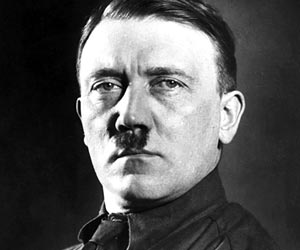 The reader merely has to consider the chronology to see that his story is impossible. Adolf Hitler wrote his Mein Kampf, full of “Aryan racial supremacy and the inherent ‘sub-humanity’ of other people” in 1923, when Maximiani Portas was a young student and Savarkar a prisoner.
Until then, Savarkar had only written a few books about Indian history, which didn’t interest Hitler, and about the anti-colonial struggle, which Hitler strongly opposed.
So no, Savarkar did not influence Hitler and did not give him the very European idea of the Aryan race. (But at least, Mein Kampf and Savarkar’s Hindutva were written at the same time and both in captivity, a likeness about which astrologers and fantasy writers like Barman could certainly think up a good story.)
Maximiani Portas brought her Aryan theory with her into India, as she had learned it in Europe. She only took Indian ideas with her back to Europe when she could leave India at long last in 1945, too late for Hitler to learn anything from her. Incidentally, she had taken the name Savitri Devi shortly after settling in India, years before she married Mukherji.
It is but one of the many mistakes of detail accumulated in Barman’s brief column. She did have a peculiar veneration for Hitler as well as for Genghis Khan and for Pharaoh Akhenaten, the founder of monotheism and iconoclasm (a tradition that has particularly victimized Hinduism through Islam).
She prefigured the many Westerners who have travelled to India to brew their own combination of Hindu and Western ideas, and who often ended up getting sun-struck.
 What Barman strategically omits, is that after the outbreak of World War 2, Savarkar immediately offered help in the anti-Nazi war effort and started recruiting for the British-Indian Army.
Indeed, Gandhi would deride him as a “recruiting officer”, forgetting how he himself as a British loyalist had recruited Indian volunteers for the British war effort in the Boer War, the Zulu War and World War 1.
Of course, in Barman’s game, it is “heads Hindus lose, tails anti-Hindus win”: if Savarkar had sided with the Axis against the British (as the secular Leftist Subhas Bose did), he would have been denounced as a proven Nazi, and now that he worked for the opposing camp, he is denounced as a British toady.
In reality, he had only India’s best interests at heart, which he thought were best served by enlisting in the British-Indian Army, just as Bose thought that enlisting in the Axis Armies was the best course to India’s independence. Barman with his puny divisive ideas would not understand, but Savarkar and Bose, for all their differences, were first of all patriots.
Conclusion

Whereas Nehruvians like to portray the RSS-BJP as a formidable enemy mercilessly pursuing the Hindu agenda, the fact is that most BJP stalwarts prefer to keep the Hindu agenda as far removed from their policies as possible. They serve their time in government and enjoy the perks of office, meanwhile hopefully cleaning up the economic mess that Congress has left behind, but never touching a serious Hindu concern with a barge-pole.
This even counts for the Prime Minister, whom Barman and his ilk have spent a dozen years demonizing as a Hindu fanatic.
The Hindutva once espoused by the Jan Sangh (1952-77) should be updated, the old formulas should be allowed to evolve, of course. But most BJP stalwarts are not interested in any evolution of their ideology, the only evolution they can conceive of is betrayal.
They have never developed an ideological backbone; instead, they have continuously borrowed conclusions from the Nehruvians and others who did their own thinking for non-Hindu purposes. They had the pick-pocket mentality of getting things on the cheap, of being mentally lazy and borrowing their ideas from elsewhere.
That is why both BJP Prime Ministers thus far, Atal Behari Vajpayee and now Modi, have professed their secularism. No, not age-old Hindu “secularism” (in the sense of religious pluralism) but the anti-Hindu ideology that is falsely called “secularism”. They essentially live up to the standards set by their enemies because their movement has never seriously developed a perspective of its own.
Also Read
Was Veer Savarkar a Nazi?
(2208)
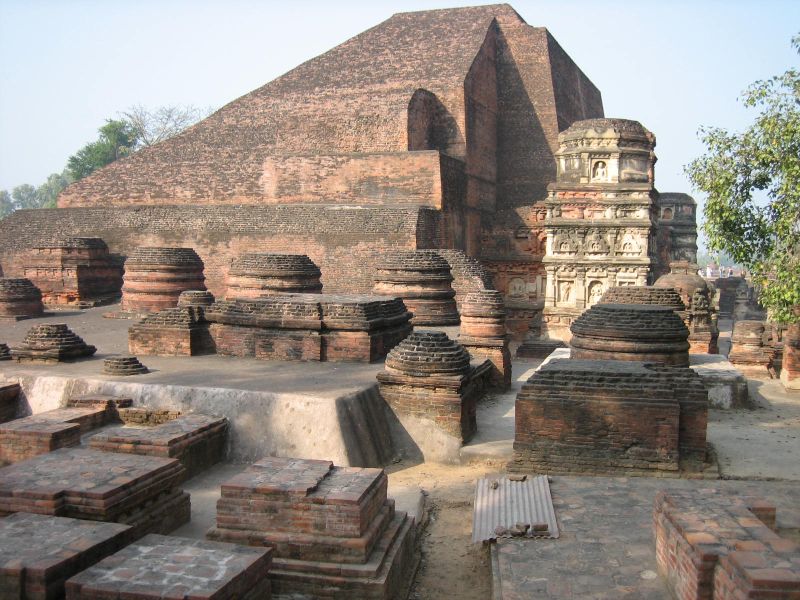 Jha becomes distinctly unpleasant when he starts throwing around allegations: “In his zeal, [Shourie] fudges and concocts historical evidence and ignores the fact that Bakhtiyar did not go to Nalanda from Bihar (Biharsharif). Instead, he proceeded to Nadia in Bengal through the hills and jungles of the region of Jharkhand, which, incidentally, finds first mention in an inscription of AD 1295 (Comprehensive History of India, vol. IV, pt. I, p.601). I may add that his whole book, Eminent Historians, from which the article under reference is excerpted, abounds in instances of his cavalier attitude to historical evidence.”
 Jha’s final word: “Shourie had raised a huge controversy by publishing his scandalous and slanderous Eminent Historians in 1998 during the NDA regime and now, after sixteen years, he has issued its second edition, from which the article under reference has been excerpted. He appears and reappears in the historian’s avatar when the BJP comes to power and does all he can to please his masters. His view of the past is no different from that of the Vishwa Hindu Parishad and the Rashtriya Swayamsevak Sangh and their numerous outfits, consisting of riff-raff and goons who burn books that do not endorse their views, who vandalize art objects which they label blasphemous, who present a distorted view of Indian history, and who nurture a culture of intolerance. These elements demanded my arrest when my book on beef-eating was published, and they censured James Laine when his book on Shivaji came out. It is not unlikely that Shourie functions in cahoots with people like Dina Nath Batra, who targeted A K Ramanujan’s essay emphasizing the diversity of the Ramayana tradition; Wendy Doniger’s writings, which provided an alternative view of Hinduism; Megha Kumar’s work on communalism and sexual violence in Ahmedabad since 1969; and Sekhar Bandopadhyaya’s textbook on modern India, which regrettably does not eulogise the RSS. Arun Shourie seems to have inaugurated a fresh round of battle by fudging, falsifying and fabricating historical evidence and providing grist to Batra’s mill.”
 At the end of 1990, Sita Ram Goel and myself visited the VHP headquarters at RK Puram, Delhi. To some of their bigwigs (names available), I argued passionately that since they had been forced to make a historical case for their Ayodhya demand, and for other reasons too, they badly needed to invest in serious history-writing, rather than relying on either the output furnished by their enemies or the caricatures produced by incompetent Hindus of the PN Oak variety. Wise old Goel just smiled, knowing already what the effect of my enthusiastic plea would be. One VHP leader concluded the conversation by assuring me: “We will think about your suggestion”— the polite way of saying: “Drop dead.” As we left, Goel said: “You could just as well have talked to my wall.” The Sangh Parivar was determined not to invest in chicken but only in eggs; not to involve itself in building a Hindu worldview but to continue focusing on empty locomotion.


 The concept of Cakravarti (“wheel-turner”, universal ruler) was in fact much older than Ashoka, and the 24-spoked wheel can also be read in other senses, e.g. the Sankhya philosophy’s worldview, with the central Purusha/Subject and the 24 elements of Prakrti/Nature. The anglicized Nehru, “India’s last Viceroy”, prided himself on his illiteracy in Hindu culture, so he didn’t know any of this, but was satisfied that these symbols could glorify Ashoka and belittle Hinduism, deemed a separate religion from which Ashoka had broken away by accepting Buddhism.
 At 29, he renounced society, but not Hinduism. Indeed, it is a typical thing among Hindus to exit from society, laying off your caste marks including your civil name. The Rg-Veda already describes the Muni-s as having matted hair and going about sky-clad: such are what we now know as Naga Sadhus. Asceticism was a recognized practice in Vedic society long before the Buddha. Yajnavalkya, the Upanishadic originator of the notion of Self, renounced life in society after a successful career as court priest and an equally happy family life with two wives. By leaving his family and renouncing his future in politics, the Buddha followed an existing tradition within Hindu society.
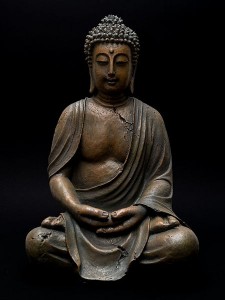 On caste, we find him is full cooperation with existing caste society. Being an elitist, he mainly recruited among the upper castes, with over 40% Brahmins. These would later furnish all the great philosophers who made Buddhism synonymous with conceptual sophistication. Conversely, the Buddhist universities trained well-known non-Buddhist scientists such as the astronomer Aryabhata.
 Did he achieve this by saying that birth is unimportant, that “caste is bad” or that “caste doesn’t matter”, as the Ambedkarites claim? No, he reminded the king of the old view (then apparently in the process of being replaced with a stricter view) that caste was passed on exclusively in the paternal line. Among hybrids of horses and donkeys, the progeny of a horse stallion and a donkey mare whinnies, like its father, while the progeny of a donkey stallion and a horse mare brays, also like its father. So, in the oldest Upanishad, Satyakama Jabala is accepted by his Brahmins-only teacher because his father is deduced to be a Brahmin, regardless of his mother being a maid-servant. And similarly, king Prasenadi should accept his son as a Kshatriya, even though his mother was not a full-blooded Shakya Kshatriya.

 First of all, the extent of the Harappan civilization. An important number of cities lie outside Pakistan, from the Afghan colony of Shortugai to a large number is Gujarat, including the port of Lothal, and another large number in India, including the metropolis of Rakhigarhi. Many of these cities are near the bed of the Saraswati in Haryana, which is why Indian archeologists are entitled to speak of “Sindhu-Saraswati civilization”. The emphasis on the Indus is the result of the first discoveries, viz. of Mohenjo Daro on and Harappa near the Indus, but is now dated. Note that this civilization was much larger than the contemporary Mesopotamian civilization. If we don’t look too closely on the map, with a Martian’s glance, we might say that its borders very roughly coincide with those of Pakistan.
 This conflicts with the orthodox Islamic calculation, upheld at the time of Partition by Maulana Azad, that (1) democracy is un-Islamic so that, like for the medieval Muslim invaders, power can just as well be obtained by a strong-headed minority, and that (2) in the longer run, the Muslims would obtain the majority in united India anyway, by means of conversions and a higher demographic growth. From the Islamic viewpoint, the history of Pakistan is not important because Pakistan is not important: it can only be a temporary tactic (and not even the best) on the way to the ultimate goal, viz. the Islamization of India. But in a confrontation with the infidels, anything un-Islamic becomes Islamic by being useful in the confrontation.
 As a historical claim, his thesis is largely untrue. For instance, the Gupta and Sikh empires clearly saddled this border, and one looks in vain for a historical kingdom coinciding with the Indus territory or with modern-day Pakistan. But the geological claim is of better quality. East Panjab and Kashmir constitute Indian parts of the Indus region (or is this a veiled Pakistani claim to these regions?), but further downstream, the border does roughly coincide with the watershed defining the Indus area. But is this watershed of political or civilizational relevance? The Aegean Sea separated Greece from Ionia, the Greek area of coastal Anatolia, yet the two areas were one in language and culture. Jinnah also didn’t base his Pakistan on this watershed: he would gladly have included the Nizam’s Hyderabad and did include East Bengal, part of the supposedly un-Pakistani Ganga plain.
 He is, however, right to identify the southern Pakistani province of Sindh with the Sumerian-attested name Meluhha. That this name is the origin of the word Mleccha indicates that its people were not embraced or held in high esteem in Vedic circles. And here we run into a phenomenon that Sufyan doesn’t realize yet, but that would certainly serve him well: the areas now constituting Pakistan and Afghanistan were considered inauspicious by the Vedic people. In his book The Rigveda and the Avesta (Delhi 2009), Shrikant Talageri describes how the Northwest was held in suspicion and taken to be the home of people who brought misfortune. In the Ramayana, exile and misery are visited upon Rama and Sita by the hand of Rama’s father’s second wife Kaikeyi, who hailed from the Northwest. In the Mahabharata, the war between the Pandava and Kaurava branches of the Bharata lineage is triggered by Pandu’s death, caused by his being enamoured of Madri, again a wife of Northwestern provenance. Talageri testifies how his own Brahmin family fasted by refraining from consuming Gangetic rice, while Panjab-grown grain was not deemed real food and hence was permitted. This information would marvelously fit in with Sufyan’s project.
 The contrast between Harappa and Pakistan, or the fundamental Hinduness of the Harappans, is perhaps best illustrated with the three most famous artifacts from the Harappan civilization. The “priest-king” was probably a practitioner of the stellar cult suggested on many Harappan seal. The Quran emphatically forbids the Pagan worship of sun, moon and stars. At any rate, he was not a Muslim but a propagator of Paganism, the same kind against whom Mohammed made war. So, according to Islam, the state religion of Pakistan, the priest-king has been burning in hell for four thousand years. As for the “dancing-girl”, she exudes self-confidence and is stark naked. In today’s Pakistan, there would be no room for her. In fact, she would be stoned to death. Finally, the “Pashupati seal” may or may not depict Shiva as Lord of the Animals, but the character depicted would certainly feel more at home in a Hindu temple than in a mosque. A figure in a yoga posture clearly belongs in India more than in Pakistan. There is nothing Islamic and therefore nothing Pakistani about these three faces of the Indus civilization.
 S.N. Balagangadhara, better known as Balu, is Professor of Comparative Culture Studies in Ghent University, Belgium. Balu is a Kannadiga Brahmin by birth, a former Marxist, and his discourse has a very in-your-face quality. In his latest book, Reconceptualizing India Studies (Oxford University Press 2012), the attentive reader will see a critique of the Indological establishment in the West and the political and cultural establishment in India. Like Rajiv Malhotra’s recent works, it questions their legitimacy. The reigning Indologists and India-watchers would do well to read it.
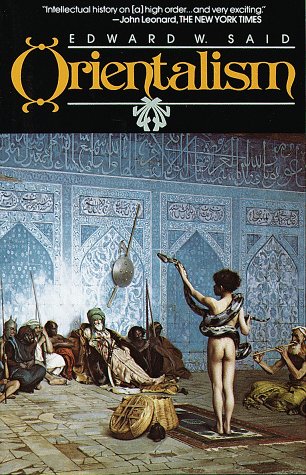 Look at the secularists, who for decades now have gone gaga over Said’s concept of Orientalism: “Orientalism is reproduced in the name of a critique of Orientalism. It is completely irrelevant whether one uses a Marx, a Weber or a Max Müller to do so. (…) the result is the same: uninteresting trivia, as far as the growth of human knowledge is concerned; but pernicious in its effect as far as Indian intellectuals are concerned.” (p.47) India has produced intellectual giants like (limiting ourselves to the 20th century:) R.C. Majumdar, P.V. Kane or A.K. Coomaraswamy, but the Indian secularists are intellectually very poor copies of their Western role models.
 Balu’s explanation of intercommunal relations in India and the state’s role therein is original and clear. In his opinion, the secular state is not there to curb religious violence, but is in fact the cause of this violence. He focuses on its position in the question of religious conversion, which is forbidden in some neighbouring countries and demanded to be forbidden by many Hindus (both Mahatma Gandhi and the Hindu nationalists). But it is upheld as a right by the Muslims and especially by the Christian missionaries — and by the “secular” state. The latter clearly takes a partisan stand in doing so; and it would also be partisan if it did the opposite. It is impossible to be impartisan.
 The whole “secular” discourse on “religion” and intercommunal relations is borrowed from Christianity. The basic framework to think about religion is informed by Western experiences and fails to see the radical difference between these and the native traditions: “the secular state assumes that the Semitic religions and the Hindu traditions are instances of the same kind” (p.203). In realities, Hindus and Parsis don’t missionize and refrain from basing their religions on a defining truth claim. By contrast, Christianity and Islam believe they offer the truth, and consequently want everyone to accept it.
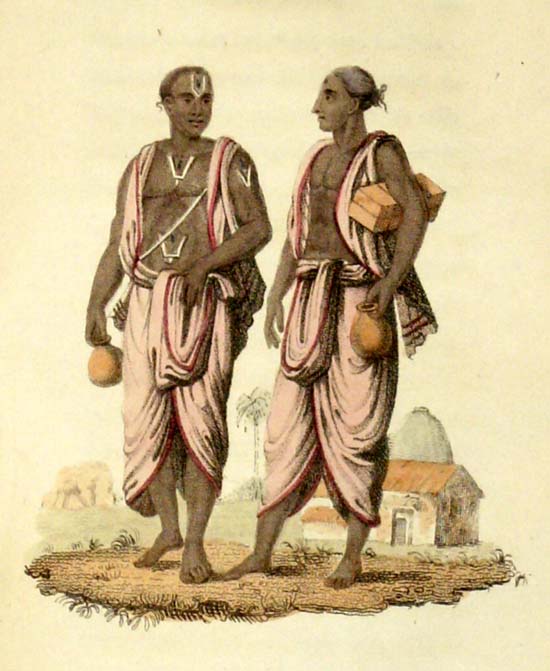 Within the Portuguese territories, physical persecution of Paganism naturally hit the Brahmins hardest. Treaties with Hindu kings had to stipulate explicitly that the Portuguese must not kill Brahmins. But in the case of Christian anti-Brahminism, these physical persecutions were a small matter compared to the systematic ideological and propagandistic attack on Brahminism, which has conditioned the views of many non-missionaries and has by now been amplified enormously because Secularists, Akalis, Marxists and Muslims have joined the chorus. In fact, apart from anti-Judaism, the anti-Brahmin campaign started by the missionaries is the biggest vilification campaign in world history (emphasis added).
 De Nobili’s approach was one possible application of the Jesuits larger strategy, which aimed at converting the elite in the hope that they would carry the masses with them. This approach had been tried in vain in China, in Japan, and even at the Moghul court (today, it is finally meeting with a measure of success in South Korea). A practical implication of this strategy was that Christianity had to be presented as a noble and elitist religion. This came naturally to the Jesuits, who (unlike, for instance, the Franciscans) styled themselves as an elite order.
 If the missionaries were sincerely unhappy with the institution of caste, it was not because of its intrinsic inequality. The problem with caste was that it offered a lot of communal togetherness, social security and a certain pride in one’s caste identity. Through the missionary propaganda, we have come to see caste as an exclusion-from, but in the first place it is a belonging-to [a community]. Even for the lowest castes, humiliation by higher placed people on account of caste did not outweigh the considerable benefits of belonging to at least some caste.
 It is therefore not true that the Church’s motivation in blackening the Brahmins had anything to do with a concern for equality. The Church was against equality in the first place, and even when equality became the irresistible fashion, the Church allowed caste inequality to continue wherever it considered it opportune to do so. As a missionary has admitted to me: in Goa, many churches still have separate doors for high-caste and low-caste people, and caste discrimination at many levels is still widespread. Commenting on the persistence of caste distinctions in the Church, a Dalit convert told me: I feel like a frog who has jumped from one muddy pool into another pool just as muddy.
 In the past century, the Churches one after another came around to the decision that the lower ranks of society should be made the prime target of conversion campaigns. Finding that the conversion of the high-caste people was not getting anywhere, they settled for the low-castes and tribals, and adapted their own image accordingly. One implication was that the Brahmins were no longer just the guardians of Paganism, but also the antipodes of the low-castes on the caste ladder. A totally new line of propaganda was launched: Brahmins were the oppressors of the low-caste people.
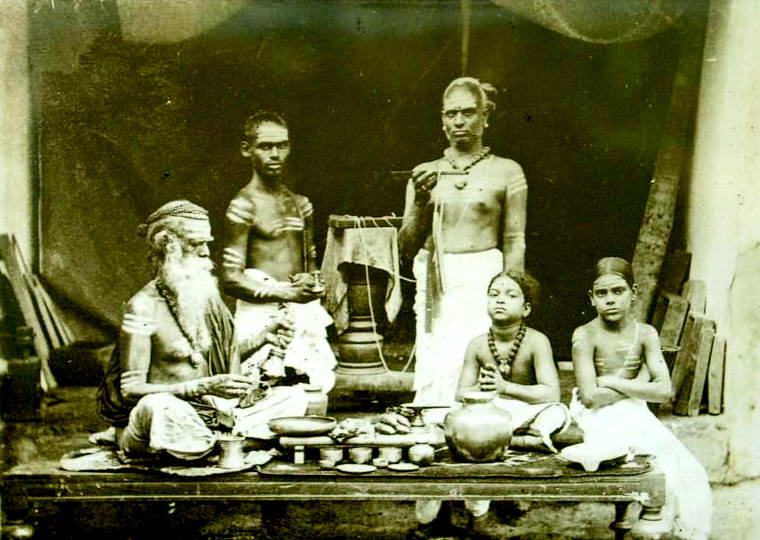 Then again, the Aryan Invasion theory was the alpha and omega of the version of India history spread by anti-Brahminism.[5] Phule’s book Slavery starts out with this view of history: “Recent researches have shown beyond a shadow of a doubt that the Brahmins were not the Aborigines of India…. Aryans came to India not as simple emigrants with peaceful intentions of colonisation, but as conquerors. They appear to have been a race imbued with very high notions of self, extremely cunning, arrogant and bigoted.”
 Even among the champions of the Hindu cause, anti-Brahminism acquired a following. The Hindu reform movement Arya Samaj rejected Brahminism and its heretical brainchildren, idolatry and the caste system, as utterly non-Vedic. Brahmin temples were desecrated in the name of Hinduism. Orthodox Brahmins were attacked as the traitors of Hindu interests.