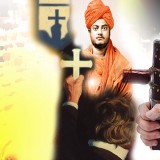
Vivekananda not only carried the message of Hinduism to the USA and Europe during his two trips from 1893 to 1897 and from 1899 to 1900, he also turned the tide against Christianity in India so far as educated, upper class Hindus were concerned. Henceforward, Christian missionaries would reap a harvest either in the tribal belts or during famines when charitable organisations abroad and a patronising government at home placed funds for relief at their disposal and Hindu orphans fell into their hands in large numbers.
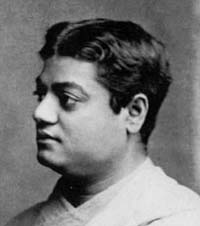 Vivekananda himself symbolised an irony of that system of education which had been deliberately designed to demolish Hinduism and promote Christianity. He was himself a product of that very education, but he turned against Christianity and in defence of Hinduism the knowledge and intellectual discipline which he had acquired as a student in a missionary college.
The renewal of East India Company’s Charter in 1813 had opened the Company’s dominions to Christian missionaries. It had also advised “introduction of useful knowledge and religious and moral improvement.” A controversy had been going on ever since regarding the system of education suitable for India. The Orientalists among the British rulers advocated retention of the traditional Indian system. They were afraid that imparting of Western knowledge to natives would encourage them to claim equality with white men and demand democratisation of the administration. The Anglicists, on the other hand, were convinced that knowledge of Western literature, philosophy and science would wean Hindus away from their “ancestral superstitions” and draw them closer to the religion and culture of the ruling race.
Christian missionaries were, by and large, with the Anglicists. One of them had written in 1822 that, through Western education, Hindus “now engaged in the degrading and polluting worship of idols shall be brought to the knowledge of true God and Jesus Christ whom He has sent.” Missionaries felt immensely strengthened when Alexander Duff, an ardent advocate of Western education, reached Calcutta in 1830.
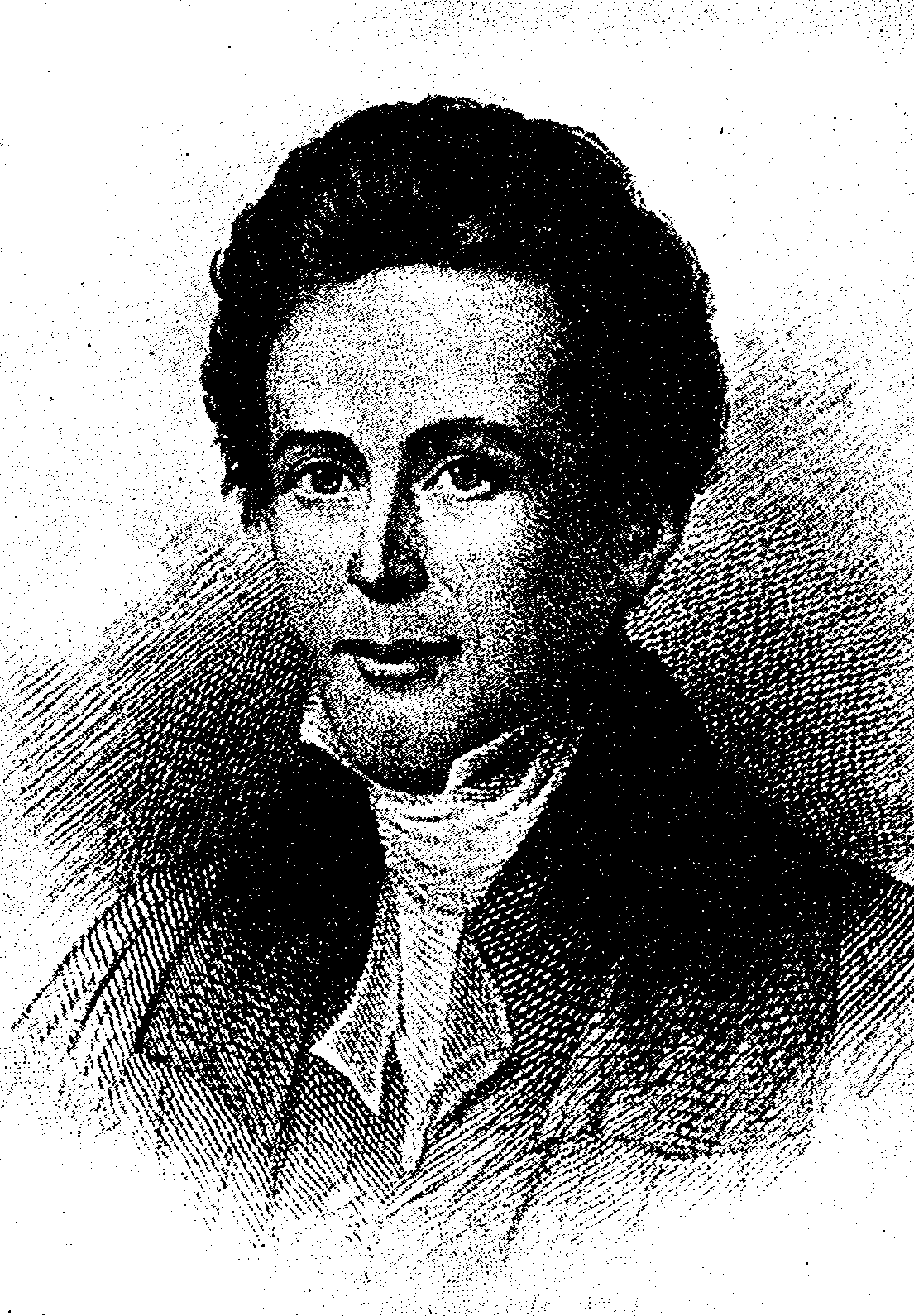 Alexander Duff was convinced that “of all the systems of false religion ever fabricated by the perverse ingenuity of fallen men, Hinduism is surely the most stupendous and that India was “the chief seat of Satan’s earthly dominion.”
He studied for some time the effect which Western education was having on Hindu young men attending the Hindu College and similar institutions which had come up in Calcutta and elsewhere in Bengal since more than a decade before his arrival. He came to the definite conclusion that Western education would make the Hindus “perfect unbelievers in their own system” and “perfect believers in Christianity.” In an address delivered in 1835 to a General Church Assembly he proclaimed that knowledge of Western literature and science would “demolish the huge and hideous fabric of Hinduism” brick by brick till “the whole will be found to have crumbled into fragments.”
A Committee of Public Instruction had been set up by the Government for recommending a suitable system of education. Alexander Duff had been made a member of the Committee in 1834. Next year, T. B. Macaulay, a member of the Governor General’s Council, was appointed to preside over the Committee. He wrote a Minute on February 2, 1835, advocating Western education. There was a tie between the Anglicists and the Orientalists when the Minute came before the Committee on March 7. Macaulay used his casting vote and forced a decision. The Western system of education was adopted. In a letter written to his father in 1836, Macaulay predicated,
“It is my firm belief that if our plans of education are followed up, there will not be a single idolator among the respectable classes of Bengal thirty years” hence.
The missionaries were trying hard to turn the dream into a reality. “And in what country,” Louis Rousslet, a French traveller to India, wrote in 1876,
“could such a spectacle be witnessed as that which met my eyes that day in this square of Benares?
There, at ten paces from all that the Hindoo holds to be most sacred in religion, between the Source of wisdom and the idol of Siva, a Protestant missionary had taken his stand beneath a tree.Mounted on a chair, he was preaching in the Hindostani language, on the Christian religion and the errors of paganism.
I heard his shrill voice, issuing from the depths of a formidable shirt-collar, eject these words at the crowd, which respectfully and attentively surrounded him You are idolaters; that block of stone which you worship has been taken from a quarry, it is no better than the stone of my house. The reproaches called forth no murmur; the missionary was listened to immovably, but his dissertation was attended to, for every now and then one of the audience would put a question, to which the brave apostle replied as best as he could.
Perhaps we should be disposed to admire the courage of the missionary if the well-known toleration of the Hindoos did not defraud him of all his merit; and it is this tolerance that most disheartens the missionary one of whom said to me – our labours are in vain; you can never convert a man who has sufficient conviction in his own religion to listen, without moving a muscle, to all the attacks you can make against it.”
 The fond hope that Hinduism will die out before long was expressed by Richard Temple before a Christian audience in England in 1883. “India is like a mighty bastion,” he wrote, “which is being battered by heavy artillery. We have given blow after blow, and thud after thud, and the effect is not at first very remarkable; but at last with a crash the mighty structure will come toppling down, and it is our hope that some day the heathen religions of India will in like manner succumb.”
At the same time, he felt sure that Christianity had a very bright future in India.
“But we are not chasing a shadow,” he continued, “we are not rolling a Sisyphean stone, we are not ascending an inaccessible hill; or, if we are going up hill, it is that sort of ascent which soon leads to a summit, from which we shall survey the promised land. And when we reach the top what prospect shall we see? We shall see churches in India raising up their spires towards heaven, Christian villages extending over whole tracts of country, churches crowded with dusky congregations and dusky communicants at the altar tables.
We shall hear the native girls singing hymns in the vernacular, and see boys trooping to school or studying for the universities under missionary auspices. Those things, and many others, I have seen, and would to God I could fix them on the minds of my audience as they are fixed upon my own.”
Vivekananda shattered the hope and the dream in the next decade.
 Narendranath Datta, who was to become Swami Vivekananda, was born in 1863, the year when Alexander Duff left India well satisfied that Hinduism was on its way out and Christianity on its way in, at least in Bengal. Macaulay’s prediction appeared to be coming true as there had been a spate of conversions to Christianity.
In 1832 Alexander Duff had converted Krishnamohan Banerji, a student of the Hindu College. Banerji, in turn, converted fifty-nine young men in the next few years. He became a minister of the Christ Church and was “instrumental in converting several hundred Hindus in Krishnanagar in 1839.” The other important converts made by Duff were K. C. Banerji and M. L. Basak in 1839 and Lal Behari De and Madhusudan Dutta in 1843.
Leaders of the Brahmo Samaj were perturbed and tried to arrest the trend. A meeting held in Calcutta in May 1845 and attended by a thousand Hindus, gave a call that Hindus should not send their boys to missionary schools and colleges. Some funds were collected for promoting Hindu educational and humanitarian institutions. But their efforts did not make much headway.
The missionaries commanded much larger resources and official patronage. There was a craze for Western education which was thought best when imparted in missionary institutions. Moreover, the coming of Keshub Chunder Sen to the top i n the Brahmo Samaj gave a further blow to Hinduism. He was infatuated with Jesus and the Bible and made hysterical outbursts in praise of both.
The only resolute defender of Hinduism in this intellectually hostile atmosphere was Bankim Chandra Chatterji. He was well-versed in Western literature and philosophy and his knowledge of Hindu Shastras and history was deep as well as discerning. He had come to the definite conclusion that Hindus had nothing to learn from Christianity. For him, Jesus was “an incomplete man”, the Christian God “a despot” and the Christian doctrine of everlasting punishment “devilish”. He repudiated the missionary accusation that Hinduism was responsible for corruptions that had crept into Hindu society in the course of history. “If the principles of Christianity,” he wrote, “are not responsible for the slaughter of the crusades, the butcheries of Alva, the massacre of St. Bartholomew or the flames of the Inquisition… If the principles of Christianity are not responsible for the civil disabilities of Roman Catholics and Jews which till recently disgraced the English Statute Book, I do not understand how the principles of Hinduism are to be held responsible for the civil disabilities of the sudras under the Brahmanic regime.
The critics of Hinduism have one measure for their own religion and another for Hinduism.” For him, Sri Krishna was the highest ideal, both human and divine. His novels and essays were creating a consciousness of pride in the Hindu heritage in that large section of Hindu society which had not yet passed under the spell of Jesus.
 Narendranath was a student in Alexander Duffs General Assembly’s Institution which later on became the Scottish Church College. He had made a wide study of Western literature, history and philosophy, had joined the Brahmo Samaj and come to share Keshub Chunder Sen’s admiration for Jesus.
But a turning point came in his life when he met Sri Ramakrishna Paramahamsa in November 1880. For the first time, he was face to face with a powerful expression of Hindu spirituality and that, too, in a simple man who had not been even to a primary school. His travels all over India after Sri Ramakrishna’s death gave him further glimpses of how Hindu spirituality had percolated effortlessly to the lowest levels of Hindu society. He was thus in a position to process Christianity from the vantage point of a new vision. In the end, he frustrated Alexanders Duff’s hope and falsified Macaulay’s and Temple’s prediction.
Sri Ramakrishna had never heard of Jesus till Jesus was thrust under his nose by those disciples who had come to him from the fold of Keshub Chunder Sen. Mahendra Nath Gupta, whose record of the talks of Sri Ramakrishna was to become famous as The Gospel of Sri Ramakrishna had an infantile fascination for Jesus and never missed an opportunity to compare the sayings and doings of Jesus with those of the Paramahamsa.
But to the last, Jesus remained for Sri Ramakrishna only a figure which people belonging to a foreign religion worshipped as God. He did not have even a remote knowledge of the dogmas of Christianity. The only dogma, that of the original sin, which was presented to him by some disciples, he repudiated with repugnance. “Once someone gave me,” he said on October 27, 1882, “a book of the Christians. I asked him to read it to me. It talked about nothing but sin.” Turning to Keshub Chunder Sen, who was present, he continued, “Sin is the only thing one hears at your Brahmo Samaj too… He who says day and night, ‘I am a sinner, I am a sinner’, verily becomes a sinner…
Why should one only talk about sin and hell, and such things?” Thus he knocked the bottom out of Christianity. Without sin, there was no need for the atoning death of a historical saviour.
Vivekananda carried forward the same idea. “The greatest error,” he said, “is to call a man a weak and miserable sinner. Every time a person thinks in this mistaken manner, he rivets one more link in the chain of avidyA that binds him, adds one more layer to the “self-hypnotism” that lies heavy over his mind.” He compared the Hindu and Christian concepts of the soul. “One of the chief distinctions,” he said, “between the Vedic and the Christian religion is that the Christian religion teaches that each human soul had its beginning at its birth into this world, whereas the Vedic religion asserts that the spirit of man is an emanation of the Eternal Being and has no more a beginning than God Himself.” He hailed humans as Children of Immortal Bliss – amritasya putrAH – in the language of the Upanishads. “Ye are the children of God,” he proclaimed while addressing the Parliament of Religions, “the sharers of immortal bliss, holy and perfect beings. Ye divinities on earth – sinners! It is a sin to call man so; it is a standing libel on human nature. Come up, lions! and shake off the delusion that you are sheep; you are souls immortal, spirits free, blest and eternal.”
Vivekananda repudiated the idea of vicarious saving also. He proclaimed the Hindu doctrine that everyone has to work out his own salvation. “The Christians believe,” he said, “that Jesus Christ died to save man. With you it is belief in a doctrine, and this belief constitutes your salvation. With us doctrine has nothing whatever to do with salvation.
Each one may believe in whatever doctrine he likes; or in no doctrine. What difference does it make to you whether Jesus Christ lived at a certain time or not? What has it to do with you that Moses saw God in the burning bush? The fact that Moses saw God in the burning bush does not constitute your seeing him, does it?… Records of great spiritual men in the past do us no good whatever except that they urge us onward to do the same, to experience religion ourselves. Whatever Christ or Moses or anybody else did, does not help us in the least, except to urge us on.”
He was aware that the historicity of Christ had become highly controversial among scholars of the subject. “There is a great dispute,” he wrote, “as to whether there ever was born a man with the name of Jesus. Of the four books comprising the New Testament, the Book of St. John has been rejected by some as spurious. As to the remaining three, the verdict is that they have been copied from ancient books; and that, too, long after the date ascribed to Jesus Christ.
 Moreover, about the time that Jesus is believed to have been born, among the Jews themselves there were born two historians, Josephus and Philo. They have mentioned even petty sects among the Jews but not made the least reference to Jesus or the Christians or that the Roman judge sentenced him to death on the cross. Josephus’ book had a single line about it, which has now been proved to be an interpolation. The Romans used to rule over the Jews at that time, and the Greeks taught them all arts and Sciences.
They have all written a good many things about the Jews but made no mention of either Jesus or the Christians.” He also knew that doubts had been raised whether Jesus had himself said what was attributed to him in the gospels. “Another difficulty,” he continued, “is that the sayings, precepts, or doctrines which the New Testament preaches were already in existence among the Jews before the Christian era, having come from different quarters, and were being preached by Rabbis like Hillel and others.”
The miracles of Christ also failed to impress Vivekananda. In fact, they repelled him strongly. “What were the great powers of Christ,” he asked, “in miracles and healing, in one of his characters? They were low, vulgar things because he was among vulgar beings… Any fool could do those things. Fools heal others, devils can heal others. I have seen horrible demoniacal men do wonderful miracles. They seem to manufacture fruits out of the earth. I have known fools and diabolical men tell the past, present and future. I have seen fools heal at a glance, by the will, the most horrible diseases. These are powers, truly, but often demoniacal powers.” And he was not at all interested in the historical Jesus. “One gets sick at heart,” he said, “at the different accounts of the life of the Christ that Western people give. One would make him a great politician; another, perhaps, would make of him a great military general, another a great patriotic Jew; and so on.”
What interested him was Jesus the spiritual teacher. He saw several points of strength in the life and teachings of Jesus, particularly the purity of heart and renunciation of worldly pursuits. “If you want to be Christian,” he said, “it is not necessary to know whether Christ was born in Jerusalem or Bethlehem or just the exact date on which he pronounced the Sermon on the Mount; you only require to feel the Sermon on the Mount. It is not necessary to read 2000 words on when it was delivered. All that is for the enjoyment of the learned. Let them have it; say amen to that. Let us eat the mango.”
Christians were welcome to seek salvation through Christ. According to Hinduism, everyone has the right to choose his own ishTadeva. “It is absolutely necessary,” he said, “to worship God as man, and blessed are those races which have such a ‘God-man’ in Christ; therefore, cling close to Christ; never give up Christ.
 That is the natural way to see God in man. All our ideas of God are concentrated there.” Christians go wrong only when they insist that Christ is the only saviour. “The great limitation Christians have,” he continued, “is that they do not heed other manifestations of God besides Christ.
He was a manifestation of God; so was Buddha, so were some others, and there will be hundreds of others. Do not limit God anywhere.”Delivering a lecture on ‘Christ, the Messenger’, he quoted Sri Krishna, “Wherever thou findest a great soul of immense power and purity struggling to raise humanity, know that he is born of My splendour, that I am working there through him.” And he advised the Christians, “Let us, therefore, find God not only in Jesus of Nazareth but in all the great ones that have preceded him, in all that came after him, and all that are yet to come. Our worship is unbounded. They are all manifestations of the same infinite God.”
Yet it was Christ that Vivekananda found missing from Christianity. He wondered which Church, if any, represented Christ. All churches were equally intolerant, each threatening to kill those who did not believe as it did. The person of Christ rather than his teaching had become more important for Christianity. He had been turned into the “only begotten son of God.”Christian baptism remained external and did not touch the inner man. It aimed at instilling some mental beliefs and not at transforming human behaviour.
Most men remained the same after baptism as they were before it. What was worse, the mere sprinkling of water over them and muttering of formulas by a priest made them believe that they were better than other people. He quoted the Kenopanishad in this context
: “Ever steeped in the darkness of ignorance, yet considering themselves wise and learned, the fools go round and round, staggering to and fro like the blind led by the blind.”
The Eucharist was nothing more than the survival of a savage custom.
“They sometimes killed their great chiefs,” said Vivekananda, “and ate their flesh in order to obtain in themselves the qualities which made their leaders great.” Human sacrifice was a Jewish idea which was borrowed by Christianity “in the form of atonement.” This seeking for a “scapegoat” had made Christianity “develop a spirit of persecution and bloodshed.”
Christian missionaries were attacking the Puranas for containing passages which they considered somewhat obscene. Vivekananda had studied the Bible and knew that it contained a lot which was downright pornography. But he had his own method of exposing the Bible. “The Chinese,” he wrote, “are the disciples of Confucius, are the disciples of Buddha, and their morality is quite strict and refined. Obscene language, obscene books, pictures, any conduct the least obscene – and the offender is punished then and there.
 The Christian missionaries translated the Bible into Chinese tongue. Now in the Bible there are some passages so obscene as to put to shame some of the Puranas of the Hindus. Reading those indecorous passages, the Chinamen were so exasperated against Christianity that they made a point of never allowing the Bible to be circulated in their country… The simpleminded Chinese were disgusted, and raised a cry, saying: Oh, horror! This religion has come to us to ruin our young boys, by giving them this Bible to read… This is why the Chinese are very indignant with Christianity. Otherwise the Chinese are very tolerant towards other religions. I hear that the missionaries have printed an edition, leaving out the objectionable parts; but this step has made the Chinese more suspicious than before.”
The history of Christianity in Europe and elsewhere had simply horrified Vivekananda, as it does any person with any moral sensibility. Besides being blood-soaked, Christianity has been inimical to all free enquiry. “The ancient Greeks,” wrote Vivekananda, “who were the first teachers of European civilisation attained the zenith of their culture long before the Christians.
 Ever since they became Christians, all their learning and culture was extinguished.” When he was passing by Egypt on his way to Europe, a missionary mentioned to him the miracles which, according to the Bible, Moses had performed in that country. But Vivekananda had read history. He knew the record of Christianity in Egypt.
“Here was the city of Alexandria,” he said, “famous all over the world for its university, its library, and its literati – that Alexandria which, falling into the hands of illiterate, bigoted and vulgar Christians suffered destruction, with its library burnt to ashes and learning stamped out. Finally, the Christians killed the lady savant, Hypatia, subjected her dead body to all sorts of abominable insult, and dragged it through the streets, till every bit of flesh was removed from her bones.”
Christianity had spread with the help of the sword since the days of Constantine and tried to suppress science and philosophy. “What support,” asked Vivekananda,
“has Christianity ever lent to the spread of civilisation, either spiritual or secular? What reward did the Christian religion offer to the European Pandit who sought to prove for the first time that the Earth is a revolving planet? What scientist has ever been hailed with approval and enthusiasm by the Christian Church?”
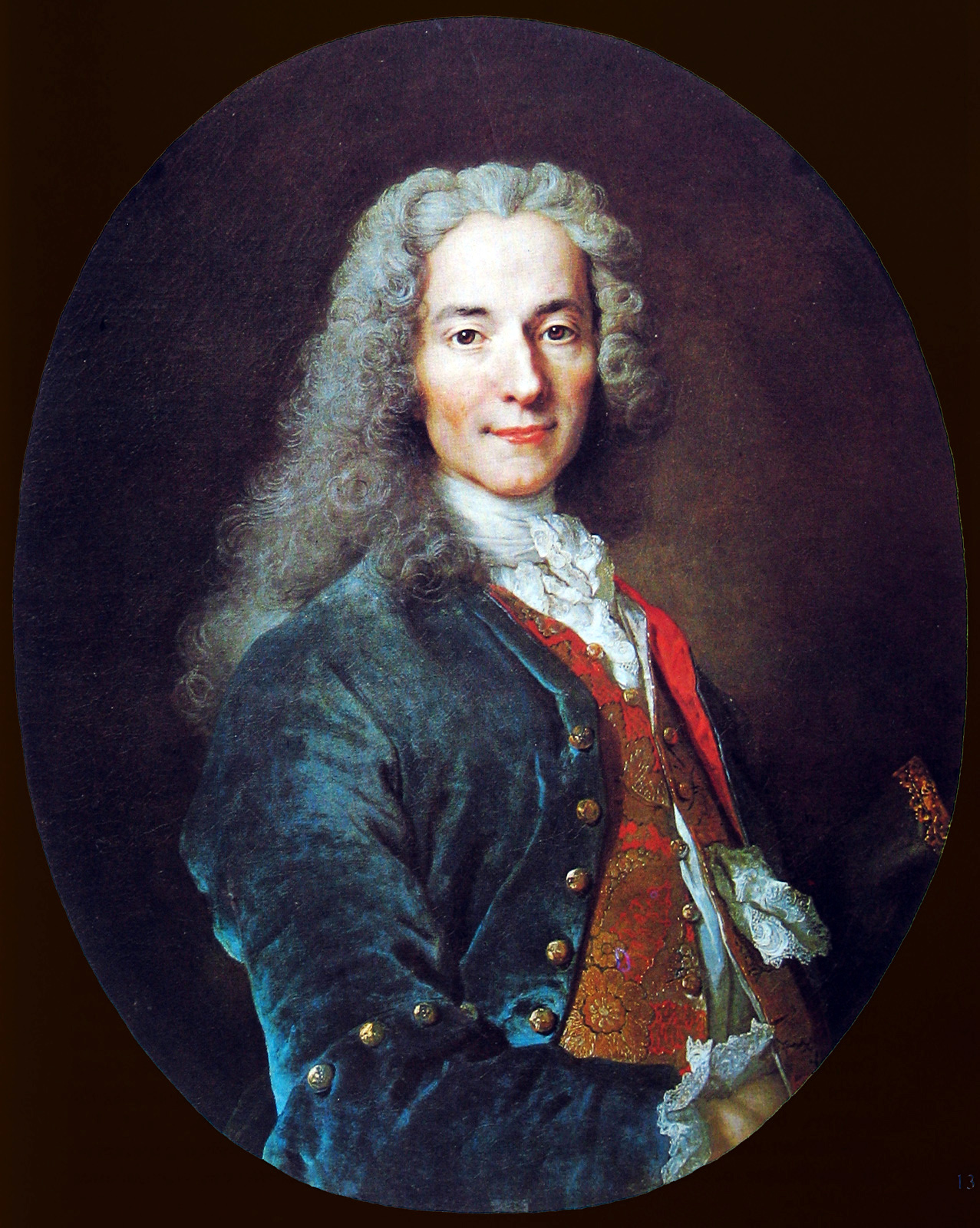 Coming to modem times, Vivekananda found Christianity very vindictive: “The great thinkers of Europe Voltaire, Darwin, Buchner, Flammarion, Victor Hugo and a host of others like him – are in the present time denounced by Christianity and are victims of vituperative tongues of its orthodox community.”
Christian missionaries in India were crediting to Christianity the rise and progress of modern Europe. This was a great falsehood. “Whatever heights of progress Europe has attained,” continued Vivekananda, “every one of them has been gained by its revolt against Christianity – by its rising against the Gospel. If Christianity had its old paramount sway in Europe today, it would have lighted the fire of the Inquisition against such modern scientists as Pasteur and Koch, and burnt Darwin and others of his school at the stake.
In modern Europe Christianity and civilization are two different things. Civilization has now girded up her loins to destroy her old enemy, Christianity, to overthrow the clergy and to wring educational and charitable institutions from their hands. But for the ignorance-ridden rustic masses, Christianity would never have been able for a moment to support its present despised existence, and would have been pulled out by its roots; for the urban poor are, even now, enemies of the Christian Church!”
Christian missionaries were citing the prosperity of the modern West as an example of the superiority of Christianity. Much of that prosperity, however, was derived from the plunder of other peoples. “We who have come from the East,” he 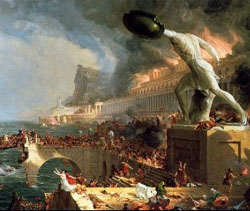 said in an interview to a U.S. newspaper on September 29, 1893, “have sat here day after day and have been told to accept Christianity because Christian nations are the most prosperous. We look about us and see England, the most prosperous Christian nation in the world, with her foot on the neck of 250,000,000 Asiatics.
We look back into history and see that the prosperity of Christian Europe began with Spain. Spain’s prosperity began with the invasion of Mexico. Christianity wins its prosperity by cutting the throats of its fellow men. At such a price the Hindu will not have prosperity. I have sat here and heard the height of intolerance. I have heard the creed of Moslems applauded, when the Moslem sword is carrying destruction into India. Blood and sword are not for the Hindu, whose religion is based on the laws of love.”
The newspaper described it as a “savage attack on Christian nations.” Vivekananda had a lot to say on Western colonialism and the massacre of natives in America, Australia, New Zealand and elsewhere. But that is not the subject at present.
What really amazed him was the utter lack of logic in Christian propaganda. “On metaphysical lines,” he wrote on his 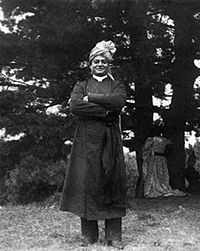 return to India in 1897, “no nation on earth can hold a candle to the Hindus; and curiously all the fellows that come over here from Christian lands have that one antiquated foolishness of an argument that because the Christians are powerful and rich and Hindus are not, so Christianity must be better than Hinduism. To which the Hindus very aptly retort that, that is the very reason why Hinduism is a religion and Christianity is not; because in this beastly world, it is blackguardism and that alone which prospers, virtue always suffers.”
Hindus have nothing to gain from Christianity as it is only a system of superstitions. Hindus should not get frightened when the missionaries threaten them with hell; in fact, hell is better than the company of a Christian missionary. “There came a Christian to me once,” recalled Vivekananda, “and said, ‘You are a terrible sinner.’ I said, ‘Yes, I am. Go on.’ He was a Christian missionary.
That man would not give me any rest. When I see him I fly. He said, ‘I have very good things for you. You are a sinner and you will go to hell.’ I said, ‘Very good, what else?’ I asked him, ‘Where are you going?’ ‘I am going to heaven,’ he answered. I said, ‘I will go to hell.’ “That day he gave me up.” If Christ could help people become good, why has he failed in the Christian countries where he has been worshipped for so long? “Here comes a Christian man,” continued Vivekananda, “and he says, ‘You are all doomed; but if you believe in this doctrine, Christ will help you out.’ If this were true – but of course it is nothing but superstition – there would be no wickedness in Christian countries. Let us believe in it – belief costs nothing – but why is there no result? If I ask, ‘Why is it that there are so many wicked people?’ They say, ‘We have to work more.’ Trust in God but keep your power dry!”
Criticism of Christianity, however, was not the primary task which Vivekananda had set for himself. He was first and foremost an exponent of Hinduism. He had to speak out about Christianity because the missionaries forced it upon him by their unceasing sallies against Hinduism. This is not the occasion even for a summary of his voluminous writings and speeches on various aspects of the subject he loved above all. We shall only touch a few points which he upheld against missionary attack.
 The missionaries were highly critical of the Vedas which Hindus have always held in the highest esteem. Vivekananda upheld the Vedas as depositories of divine wisdom. For him, scriptures like the Bible and the Quran were paurusheya, that is, revelations accessible only to particular persons whose experience could not be verified by other people. The Vedas, on the other hand, were apaurusheya, that is, statements of spiritual truths which any seeker could verify by spiritual practice. “Although we find,” he said, “many names, and many speakers, and many teachers in the Upanishads, not one of them stands as an authority of the Upanishads, not one verse is based upon the life of any one of them.
These are simple figures like shadows moving in the background, unfelt, unseen, unrealised, but the real force is in the marvellous, the brilliant, the effulgent texts of the Upanishads, perfectly impersonal. If twenty Yajnavalkyas came and lived and died, it does not matter; the texts are there. And yet it is against no personality: it is broad and expansive enough to embrace all the personalities that the world has yet produced, and all that are yet to come. It has nothing to say against the worship of persons, or Avataras, or sages.
On the other hand, it is always upholding it. At the same time, it is perfectly impersonal.”Rather than processing the Vedas in terms of the Bible, as the Brahmos had started doing, the Bible should be weighed on the Vedic scale and prove its worth. “So far as the Bible,” he observed, “and the scriptures of other nations agree with the Vedas, they are perfectly good, but when they do not agree, they are no more to be accepted.”
On another occasion he said, “It is in the Vedas that we have to study our religion. With the exception of the Vedas every book must change. The authority of the Vedas is for all time to come; the authority of every one of our other books is for the time being. For instance, one Smriti is powerful for one age, another for another age.”
Brahmanas were the next target of missionary attack. Vivekananda stood by these custodians of Hinduism. “The ideal man of our ancestors,” he said, “was the Brahmin. In all our books stands out prominently this ideal of the Brahmin. In Europe there is my Lord the Cardinal, who is struggling hard and spending thousands of pounds to prove the nobility of his ancestors and he will not be satisfied until he has traced his ancestry to some dreadful tyrant who lived on a hill and watched the people passing by, and whenever he had the opportunity, sprang out and robbed them...
In India, on the other hand, the greatest princes seek to trace their descent to .some ancient sage who dressed in a bit of loin cloth, lived in a forest, eating roots and studying the Vedas… You are of the high caste when you can trace your ancestry to a Rishi, and not otherwise… Our ideal is the Brahmin of spiritual culture and renunciation.”
Another practice of Hinduism which the missionaries never missed pillorying was idolatry. “It has become a trite saying,” said Vivekananda, “that idolatry is wrong and every man swallows it without questioning. I once thought so, and to pay the penalty of that I had to learn my lesson sitting at the feet of a man who realised everything through idols. I allude to Ramakrishna Paramahamsa. If such Ramakrishna Paramahamsas are produced by idol-worship, what will you have – the reformer’s creed or any number of idols? I want an answer.
 Take a thousand idols more if you can produce Ramakrishna Paramahamsas through idol-worship, and may God speed you! Produce such noble natures by any means you can. Yet idolatry is condemned! Why? Nobody knows. Because some hundreds of years ago some man of Jewish blood happened to condemn it? That is, he happened to condemn everybody else’s idols except his own.
If God is represented in any beautiful form or any symbolic form, said the Jew, it is awfully bad; it is sin. But if He is represented in the form of a chest, with two angels sitting on each side, and a cloud hanging over it, it is the holy of holies. If God comes in the form of a dove, it is holy. But if He comes in the form of a cow, it is heathen superstition; condemn it! That is how the world goes.
That is why the poet says, ‘what fools we mortals be!’… Boys, moustached babies, who never went out of Madras, standing up and wanting to dictate laws to three hundred millions of people who have thousands of traditions at their back!”
Lastly, he defended the caste system, the bete noire of all missionaries and reformers inspired by them. “Caste is a very good thing,” he said. “Caste is the plan we want to follow… There is no country in the world without caste. In India, from caste we reach the point where there is no caste. Caste is based throughout on that principle. The plan in India is to make everybody a Brahmin, the Brahmin being the ideal of humanity. If you read the history of India you will find that attempts have always been made to raise the lower classes. Many are the classes that have been raised. Many more will follow till the whole 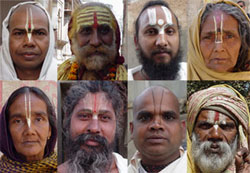 will become Brahmin. That is the plan.
We have to raise them without bringing down anybody… Indian caste is better than the caste which prevails in Europe or America. I do not say it is absolutely good. Where would you be if there were no caste? Where would be your learning and other things, if there were no caste? There would be nothing left for Europeans to study if caste had never existed. The Mohammedans would have smashed everything to pieces.” Caste was never a stationary institution. “Caste is continually changing,” said Vivekananda, “rituals are continually changing. it is the substance, the principle that does not change… Caste should not go; but should only he readjusted occasionally. Within the old structure is to be found life enough for the building of two hundred thousand new ones. It is sheer nonsense to desire the abolition of caste. The new method is – evolution of the old.”
The great strength of Hinduism is that it does not lay down one dogma for everybody as is the case with Christianity and Islam. “The fault with all religions like Christianity,” said Vivekananda, “is that they have one set of rules for all. But Hindu religion is suited to all grades of religious aspiration and progress. It contains all the ideas in their perfect form.” A universality which does not preserve individuality is false. “Individuality in universality,” he continued, “is the plan of creation...
Man is individual and at the same time .universal. It is while raising the individual that we realise even our national and universal nature.” It is because of this spirit of universality that Hinduism has never been a persecuting religion: “You know that the Hindu religion never persecutes. It is the land where all sects may live in peace and unity. The Mohammedans brought murder and slaughter in their train, but until their arrival peace prevailed.”
 The hour had come for Hinduism to carry its message abroad once more: “India was once a great missionary power. Hundreds of years before England was converted to Christianity, Buddha sent out missionaries to convert the world of Asia to his doctrine.” Vivekananda had himself given the lead. “I have planted the seed,” he wrote from America to the Raja of Khetri, “in this country; it is already a plant, and I expect it to be a tree very soon. The more the Christian priests oppose me, the more I am determined to leave a permanent mark on their country.”
It was natural that Christian missionaries should notice Vivekananda the moment he spoke at the Parliament of Religions. They had never heard of the man before. They went into action in both the U.S.A. and India and were joined by some Brahmos of Keshub’s school.
“They joined,” reported Vivekananda in a speech at Madras soon after his return, “the other opposition – the Christian missionaries. There is not one black lie imaginable that these latter did not invent against me. They blackened my character from city to city, poor and friendless though I was in a foreign country. They tried to oust me from every house and make every man who became my friend my enemy. They tried to starve me out.”
At the same time he hit out at the Brahmo leaders who saw salvation of India through Christianity. “I am sorry to say,” added Vivekananda, “that one of my own countrymen took part against me in this. He is the leader of a reform party in India. This gentleman is declaring every day, ‘Christ has come to India.’ Is this the way Christ is to come to India?… Is that the lesson that he had learnt after sitting twenty years at the feet of Christ? Our great reformers declare that Christianity and Christian power are going to uplift the Indian people. Is that the way to do it? Surely, if that gentleman is an illustration, it does not look very hopeful.”
J. Murray Mitchell who was working as a missionary in India at that time reacted adversely to reports about Vivekananda’s popularity in the U.S.A. “We fear men from the East,” he wrote, “mistook politeness with which they were received as guests for sympathy with their opinions. Very singular at all events, have been the accounts that have been transmitted to Asia regarding the effect of their exposition of the Oriental creeds.
 They had carried the war into the enemy’s country, and were everywhere victorious.” He selected P. C. Mozumdar as the real representative of “advanced and intelligent Hindus” at the Parliament of Religions. Mozumdar had said, “Representatives of all religions, may all your religions merge in the Fatherhood of God and the brotherhood of man, so that Christ’s prophecy may be fulfilled and mankind become one Kingdom under God as our Father.” Mr. Mitchell regretted that Mozumdar did not draw the applause he deserved because of his admiration for Christianity. “But Mr. Protap Chunder Mozumdar,” he said, “seems to have made much less impression than a young man who has assumed the honorofic title of Swami a step which Mr. [Keshub Chunder] Sen never ventured to take. Mr. Mozumdar appeared in plain Western dress, the Swami stood arrayed in all the colours of the rainbow. The ladies clustered around him in admiration.”
What had hurt Mr. Mitchell the most was Vivekananda’s denunciation of the doctrine of sin. “We need not dwell,” he mourned, “on the Swami’s teaching. Let one specimen suffice.” He quoted verbatim what Vivekananda had said when he hailed people at the Parliament as “sharers of bliss” and “divinities on earth.” Vivekananda had hit Christianity in its solar plexus. How could Christianity thrive without selling sin? “We are truly sorry for the man,” concluded Mr. Mitchell, “who can thus trifle with his hearers with deeply solemn questions.”
Vivekananda was rather mild in his criticism of missionaries when he spoke in the Parliament of Religions on September 29, 1893. “You Christians, who are so fond of sending out missionaries to save the soul of the heathen why do you not try to save their bodies from starvation?… You erect Churches all through India but-the crying evil in the East is not religion – they have religion enough – but it is bread that the suffering millions of burning India cry out for with parched throats… It is an insult to a starving people to offer them religion; it is an insult to a starving man to teach him metaphysics.”
He knew that missionaries were not preaching purely out of religious zeal; they had chosen the mission as a career and were paid for it. “In India,” he said, “a priest who preached for money would lose caste and be spat upon by the people.”He spoke in the same Vein when he addressed the Parliament of Religions on October 11, 1893. “Christian missionaries,” he said, “come to offer life but only on condition that the Hindus became Christians, abandoning the faith of their fathers and forefathers. Is it right?… If you wish to illustrate the meaning of ‘brotherhood’, treat Hindus more kindly even though he be a Hindu and is faithful to his religion. Send missionaries to teach them how better to earn a piece of bread, and not teach them metaphysical nonsense.”
But when he noticed that even his mild comments on missionary activities were received with great resentment in Christian circles, his tone became sharp. The Detroit Free Press dated February 21, 1894 reported a lecture which he had delivered on ‘Hindus and Christians’. Coming to Christian missionaries he said, “You train and educate and pay men to do what? To come over to my country to curse and abuse all my forefathers, my religion, and everything.
They walk near a temple and say, ‘You idolators, you will go to hell.’ But they dare not do that to the Mohammedans of India; the sword would be out. But the Hindu is too mild… And then you who train men to abuse and criticise, if I just touch you with the least bit of criticism, with the kindest purpose, you shrink and cry: ‘Don’t touch us; we are Americans. We criticise all the people in the world, curse them and abuse them, say anything, but do not touch us, we are sensitive plants?’… And whenever your ministers criticise us let them remember this:
If all India stands up and takes all the mud that is at the bottom of the Indian ocean and throws it up against the Western countries, it will not be doing an infinitesimal part of that which you are doing to us. And what for? Did we ever send one missionary to convert anybody in the world? We say to you: ‘Welcome to your religion, but allow me to have mine?’… With all your brags and boastings, where has Christianity succeeded without the sword? Show me one place in the whole world. One I say, throughout the history of the Christian religion – one; I do not want two. I know how your forefathers were converted. They had to be converted or killed; that was all. What can you do better than Mohammedanism, with all your bragging?”
As he heard the malicious propaganda against Hinduism which missionaries were mounting in America and saw ‘their methods of raising money’, he hit them hard. “What is meant,” he asked, “by those pictures in the school-books for children where the Hindu mother is painted as throwing her children to the crocodiles in the Ganga? The mother is black but the baby is painted white to arouse more sympathy, and get more money. What is meant by those pictures which paint a man burning his wife at a stake with his own hands, so that she becomes a ghost and torments the husband’s enemy?
What is meant by the pictures of huge cars crushing over human beings? The other day a book was published for children in this country, where one of these gentlemen tells a narrative of his visit to Calcutta. He says he saw a car running over fanatics in the streets of Calcutta. I have heard one gentleman preach in Memphis that in every village of India there is a pond full of the bones of little children. What have the Hindus done to these disciples of Christ that every Christian child is taught to call the Hindus vile, and ‘wretches’ and the most horrible devils on earth? Part of the Sunday School education for children here consists in teaching them to hate everybody who is not a Christian, and the Hindu especially, so that from their very childhood they may subscribe their pennies to the missions.”
Vivekananda warned the missionaries about the effect which their propaganda was having on the moral and mental health of people who listened to them. “If not for the sake of truth,” he said, “for the sake of the morality of their own children, the Christian missionaries ought not to allow such things going on. Is it any wonder that such children grow up to be ruthless and cruel men and women?… A servant-girl in the employ of a friend of mine had to be sent to a lunatic asylum as a result of her attending what they call here a revivalist-preaching. The dose of hell-fire and brimstone was too much for her.”
He saw how various missions were competing for collecting money and pouring calumny on each other. “Those to whom religion is a trade,” he observed, “are forced to become narrow and mischievous by their introduction into religion of the competitive, fighting and selfish methods of the world.”
Having witnessed their ways, many educated Americans were losing respect for the missionaries. On the other hand, they were eager to listen to exponents of other cultures. “I have more friends,” he wrote in a letter to India in 1895, “than enemies, and only a small number of the educated care about the missionaries. Again, the very fact of the missionaries being against anything makes the educated like it. They are less of a power here now, and are becoming less so every day.”
While Vivekananda caused a stir among the intellectual elite of America as was obvious from reports in the American press, the missionary circles were infuriated. “The Christian missionaries,” wrote The Indian Mirror on June 23, 1897, “rage and fume over the success of Swami Vivekananda’s mission in America. In its impotent fury, the Missionary Review of the World says that ‘Swami Vivekananda is simply a specimen of the elation and inflation of a weak man over the adulation of some silly people. If America ever gives up Christ, it will be for the devil, not Buddha or Brahma or Confucius. It will be lapse into utter apostasy, unbelief and infidelity.’ The writer, when penning these lines, was evidently under a fit of insanity brought on by the unlooked for spectacle of a Hindu preacher making disciples among American members of the Christian Church.”
The Christian Literature Society which had its headquarters in London and a branch in Madras published a book, Swami Vivekananda and his Guru with letters from prominent Americans on the alleged programme of Vedantism in United States, in 1897.
The book was reviewed by The Indian Mirror which wrote, “The object of the first part of this book is to show that, on account of his Shudra birth and for his want of knowledge as well as on the part of his Guru, Vivekananda is not qualified for teaching the Vedanta; that he, in consequence of his doings, is not entitled to be called a ‘Swami’; that Schopenhuer, the admirer of the Upanishads, was a bad man, and that Professor Max Muller (in connection with his opinion of Vedantic books) is a ‘man having two voices’.”
Rev. Dr. W. W. White, Secretary to the College Young Men’s Christian Association of Calcutta, had written to “a number of ladies and gentlemen of America, mostly belonging to missions and educational institutions” in order to find out if there was any “likelihood of America abandoning Christianity and adopting… Hinduism… in its stead.” The replies he had received were reproduced in the second part of the above-mentioned book. “Some of the writers say,” continued The Indian Mirror, “that the Swami made no impression on the people, while some others asserted that the Swami may have made a few converts, but such converts were vaccilators and seekers of novelty. All of them consoled the enquirers with the assurance that Christianity had made a firm footing in America and there was no fear of its being Supplanted by any other religion.”
Vivekananda had said again and again that he was not out to make any converts to Hinduism and that what he aimed at was the deepening and purification of Christianity which had been vulgarised by theologians and debased by missionaries. But the missionaries had their fears and wanted to be reassured that their citadel was not in danger of imminent collapse.
There was a corollary to Vivekananda’s defence of Hinduism and critique of Christianity, particularly of the Christian missions. He called upon Hindu society to open its doors and take back its members who had been alienated from it by foreign invaders. Christian as well as Islamic missionaries were taking advantage of Hindu orthodoxy which was reluctant to receive those who had been forced or lured away from the Hindu fold but who were now ready to return to the faith of their forefathers. Vivekananda viewed this orthodoxy as nothing but a blind prejudice induced by the Hindus’ deep distrust of imported creeds.
The distrust he regarded as well founded but the prejudice against victims of force or fraud as unjustified. His thoughts on the subject were expressed in an interview he gave to the representative of the Prabuddha Bharata, a monthly magazine started by his disciples in Madras. The interview, published in the April 1899 issue of the monthly, deserves to be reproduced at some length:
“I want to see you, Swami,” I began, “on this matter of receiving back into Hinduism those who have been converted from it. Is it your opinion that they should be received?”
“Certainly,” said the Swami, “they can and ought to be taken.” He sat gravely for a moment, thinking, and then resumed. “Besides,” he said, “we shall otherwise decrease in numbers. When the Mohammedans first came, we are said – I think on the authority of Ferishta, oldest Mohammedan historian – to have been six hundred millions of Hindus. Now we are about two hundred millions. And then every man going out of the Hindu pale is not only a man less, but an enemy the more.
 “Again, the vast majority of Hindu converts to Islam and Christianity are converts by the sword, or the descendants of these. It would be obviously unfair to subject these to disabilities of any kind. As to the case of born aliens, did you say? Why, born aliens have been converted in the past by crowds, and the process is still going on.
“In my own opinion, this statement not only applies to aboriginal tribes, to outlying nations, and to almost all our conquerors before the Mohammedan conquest, but also to all those castes who find a special origin in the Puranas. I hold that they have been aliens thus adopted.
“Ceremonies of expiation are no doubt suitable in the case of willing converts returning to their Mother-Church, as it were; but on those who were alienated by conquest – as in Kashmir and Nepal – or on strangers wishing to join us, no penance should be imposed.”
“But of what caste would these people be, Swamiji?” I ventured to ask. “They must have some, or they can never be assimilated into the great body of Hindus. Where shall we look for their rightful place?”“Returning converts,” said the Swami quietly, “will gain their own castes, of course. And new people will make theirs. You will remember,” he added, “that this has already been done in the case of Vaishnavism. Converts from different castes and aliens were all able to combine under that flag and form a caste by themselves,-and a very respectful one too.
From Ramanuja down to Chaitanya of Bengal, all great Vaishnava teachers have done the same.”
“And where should these new people expect to marry?” I asked. “Amongst themselves as they do now,” said the Swami quietly.
“Then as to names,” I enquired, “I suppose aliens and converts who have adopted non-Hindu names should be named newly. Would you give them caste-names, or what?” “Certainly,” said the Swami, thoughtfully, “there is a great deal in a name” and on this question he would say no more.
“But my next enquiry drew blood. ‘Would you leave these newcomers, Swamiji, to choose their own forms of religious belief out of many visaged Hinduism, or would chalk out a religion for them?’ “Can you ask that?” he said. “They will choose for themselves. For unless a man chooses for himself, the very spirit of Hinduism is destroyed. The essence of our Faith consists simply in this freedom of the Ishta.”
 Vivekananda paid a second visit to the West from June 1899 to December 1900. During his stay in California in February-May 1900, he received a gift of 160 acres from one of his American admirers. The society which he had founded during his first visit for the propagation of Vedanta, had now a home in America. It was named the Shanti Ashram.
This is not the place to tell the story of how the precedent set by Vivekananda was followed in years to come by many other Hindu missionaries.
It should suffice to say that today no country in the West is without Hindu presence in some form or the other.
Seekers in the West have become increasingly aware of the major schools of Sanatana Dharma – Yoga and Vedanta, Buddhism and Jainism, Shaivism and Vaishnavism, Shaktism and Tantra. The impact of Vivekananda in his own country was far more momentous.
He had taken over from where Bankim Chandra had left. Among the writers and thinkers of modern India, Bankim Chandra had fascinated him the most. During his lecture tour in East Bengal in 1901 he is reported to have advised Bengal’s young men to “read Bankim, and Bankim, and Bankim again.” Small wonder that Bankim’s AnandamaTha inspired revolutionary organisations fighting for India’s freedom and his Vande MAtaram became the national song par excellence when the awakening brought about by Vivekananda burst forth in a political movement soon after his death in 1902.
by Sita Ram Goel
(25088)
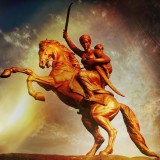
 own country with the increasing hold of the British over the political structure of India backed by its native Indian army. Everything was set for an explosion.
 When the fires of freedom were spreading the Rani had no hesitation in throwing her lot in with the freedom fighters. Her brave and steady character with her son Damodar Rao was strapped tightly to her back going onto the battlefield earned her the respect of the other fighters such as Tatya Tope, Kunwar Singh, Amar Singh , Peshwa Nana Saheb and others.
 All these disciplined and training patterns came in use during the Indian war of Independence in 1857. Many lives were lost and innocence people killed. Although India did not gain independence the Rani did win back Jhansi and created the state to its former glory having a full treasury and army of women matching the army of men.Finally, in 1858 with the rebel leaders either killed in action or hanged Sir Hugh Rose attacked Jhansi . The next day’s battle was the Rani’s last.
 Shortly there after, in 1640 CE the Mughal tyrant Shah Jahan ( of the Taj Mahal fame) dispatched Ghazi Najabat Khan with the orders to extirpate the Kafirs of the Uttarakhand. The warrior queen karnavati is said to have prepared for the invasion by leading the troops herself. She drew the Mughals to an ambush in steep mountain slopes north of Dehradun and fallen upon them with the advantage of height. The Mughal army suffered a major defeat. She is said to have prevented their retreat by blocking their rear in the narrow valley and captured several Jihadis.
 The concept of Cakravarti (“wheel-turner”, universal ruler) was in fact much older than Ashoka, and the 24-spoked wheel can also be read in other senses, e.g. the Sankhya philosophy’s worldview, with the central Purusha/Subject and the 24 elements of Prakrti/Nature. The anglicized Nehru, “India’s last Viceroy”, prided himself on his illiteracy in Hindu culture, so he didn’t know any of this, but was satisfied that these symbols could glorify Ashoka and belittle Hinduism, deemed a separate religion from which Ashoka had broken away by accepting Buddhism.
 At 29, he renounced society, but not Hinduism. Indeed, it is a typical thing among Hindus to exit from society, laying off your caste marks including your civil name. The Rg-Veda already describes the Muni-s as having matted hair and going about sky-clad: such are what we now know as Naga Sadhus. Asceticism was a recognized practice in Vedic society long before the Buddha. Yajnavalkya, the Upanishadic originator of the notion of Self, renounced life in society after a successful career as court priest and an equally happy family life with two wives. By leaving his family and renouncing his future in politics, the Buddha followed an existing tradition within Hindu society.
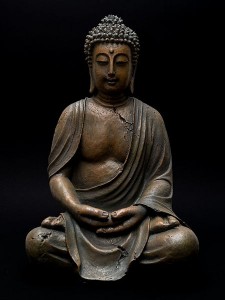 On caste, we find him is full cooperation with existing caste society. Being an elitist, he mainly recruited among the upper castes, with over 40% Brahmins. These would later furnish all the great philosophers who made Buddhism synonymous with conceptual sophistication. Conversely, the Buddhist universities trained well-known non-Buddhist scientists such as the astronomer Aryabhata.
 Did he achieve this by saying that birth is unimportant, that “caste is bad” or that “caste doesn’t matter”, as the Ambedkarites claim? No, he reminded the king of the old view (then apparently in the process of being replaced with a stricter view) that caste was passed on exclusively in the paternal line. Among hybrids of horses and donkeys, the progeny of a horse stallion and a donkey mare whinnies, like its father, while the progeny of a donkey stallion and a horse mare brays, also like its father. So, in the oldest Upanishad, Satyakama Jabala is accepted by his Brahmins-only teacher because his father is deduced to be a Brahmin, regardless of his mother being a maid-servant. And similarly, king Prasenadi should accept his son as a Kshatriya, even though his mother was not a full-blooded Shakya Kshatriya.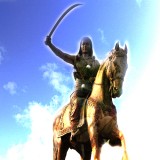
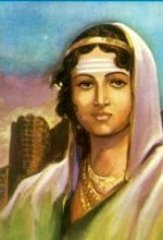
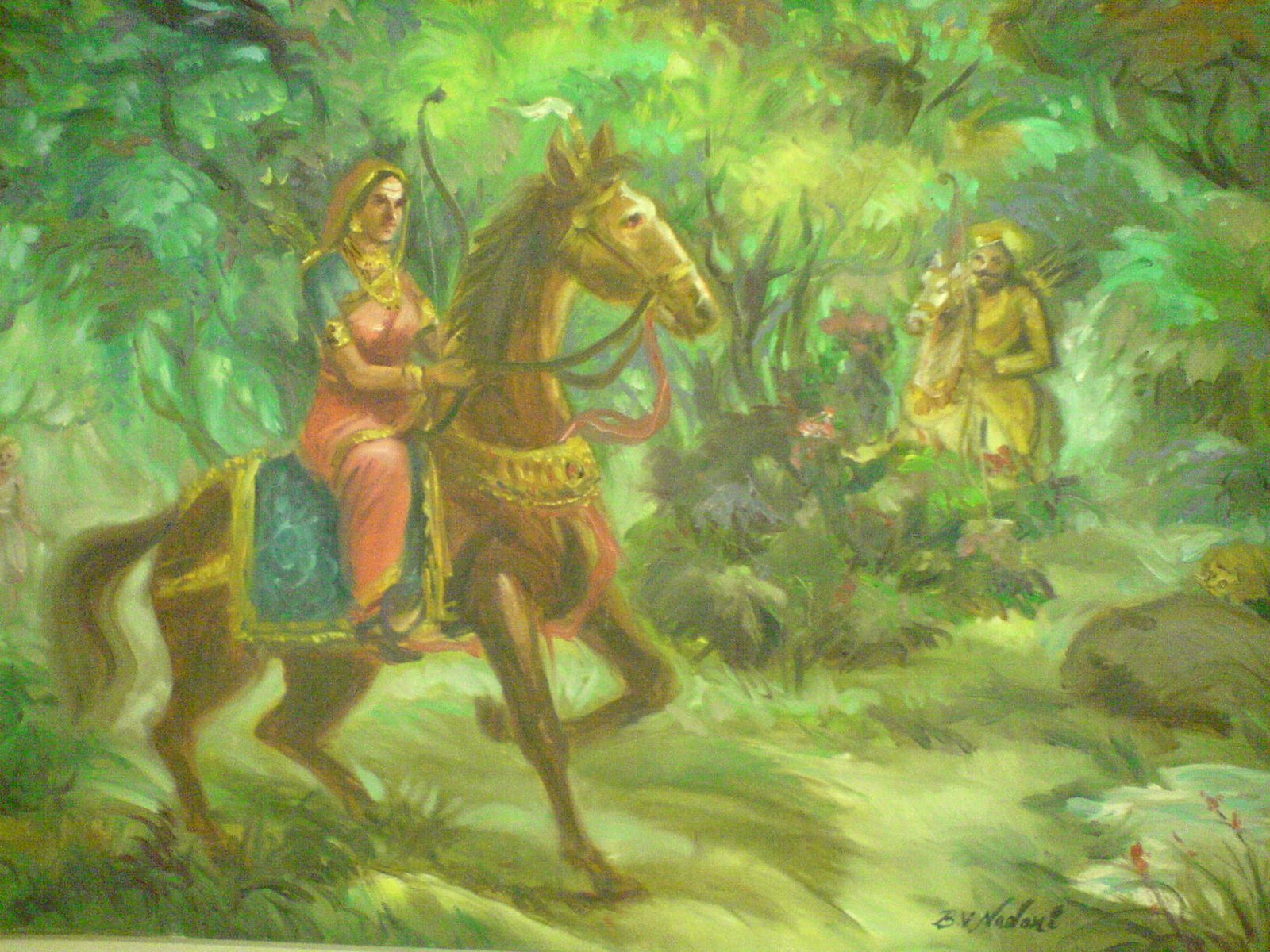 Rani Chennamma released the hostages with an understanding with Chaplin that the war would be terminated. But Chaplin treacherously continued the war with even more soldiers. Chennamma fought fiercely with the aid of her lieutenant, Sangolli Rayanna, but was ultimately captured and imprisoned at Bailhongal Fort, where she died on 21 February 1829. Sangolli Rayanna continued the guerrilla war up to 1829 until his capture, but it was in vain, and was caught due to treachery and hanged.

 n 1542, she was married to Dalpatshah, the eldest son of king Sangramshah of Gond Dynasty. Chandel and Gond dynasties got closer as a consequence of this marriage and that was the reason Keerat Rai got the help of Gonds and his son-in-law Dalpatshah at the time of invasion of Shershah Suri in which Shershah Suri died.
 This plan of Mughul invasion was the result of expansionism and imperialism of Akbar. When Rani heard about the attack by Asaf Khan she decide to defend her kingdom with all her might although her minister Adhar pointed out the strength of Mughal forces. Rani maintained that it was better to die respectfully than to live a disgraceful life.
 It started in 1681 with the Mughal emperor Aurangzeb’s invasion of Maratha empire. It ended in 1707 with Aurangzeb’s death. Aurangzeb threw everything he had in this war. He lost it all.
 At the time of Shivaji’s death in 1680, Maratha empire spanned an area far more than the current state of Maharashtra and had taken firm roots. But it was surrounded by enemies from all sides. Portuguese on northern Coast and Goa, British in Mumbai, Siddies in Konkan and remaining Deccan sultanates in Karnataka posed limited challenge each, but none of them was capable of taking down the Marathas alone. Mughal empire with Aurangzeb at its helm was the most formidable foe.
 After the death of Shivaji in 1680, a brief power struggle ensued in the royal family. Finally Sambhaji became the king. By this time Aurangzeb had finished his North missions and was pondering a final push in Deccan to conquer all of the India.
 The beginning went quite well. Shah Alam crossed Krishna river and entered Belgaum. From there he entered Goa and started marching north via Konkan. As he pushed further,he was continuously harassed by Marathas. They ransacked his supply chains and reduced his forces to starvation. Finally Aurangzeb sent Ruhulla Khan for his rescue and brought him back to Ahmednagar. The first pincer attempt failed.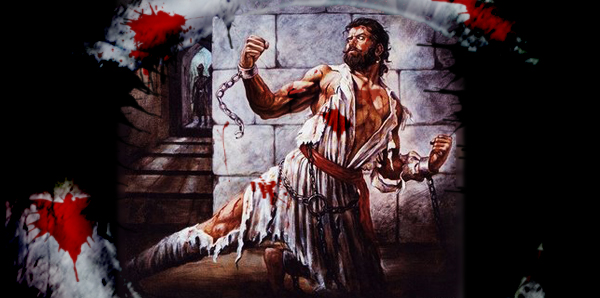
 Julfikar khan, who was orchestrating Jinji siege, left the siege on Aurangzeb’s orders and marched back. Santaji followed him to North, but was defeated by Julfikar Khan. Santaji then diverted his forces to Bijapur. Aurangzeb sent another general Kasim Khan to tackle Santaji. But Santaji attacked him with a brilliant military maneuver near Chitaldurg and forced him take refuge in Dunderi fort. The fort was quickly sieged by Santaji and the siege only ended when most of the Mughal soldiers starved and Kasim Khan committed suicide. Aurangzeb sent Himmat Khan to reinforce Kasim Khan. Himmat khan carried heavy artillery. So Santaji lured him in a trap in the forest near Dunderi. A sudden, ambush style attack on Mughals was followed by a fierce battle. The battle ended when when Himmat Khan was shot in head and died. All his forces routed and Santaji confiscated a big cache of weapons and ammunition.
 Jinji fell, but it did a big damage to the Mughal empire. The losses incurred in taking Jinji far outweighed the gains. The fort had done its work. For seven years the three hills of Jinji had kept a large contigent of mughal forces occupied. It had eaten a deep hole into Mughal resources. Not only at Jinji, but the royal treasury was bleeding everywhere and was already under strain.
 In March of 1700, another bad news followed Marathas. Rajaram took his last breath. His queen Tarabai, who was also daughter of the gallant Maratha Commander-in-Chief Hambeerrao Mohite, took charge of Maratha army. Daughter of a braveheart, Tarabai proved her true mettle for the next seven years. She carried the struggle on with equal valor. Thus began the phase 3, the last phase of the prolonged war, with Marathas under the leadership of Tarabai.
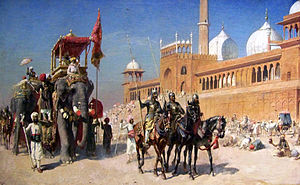 In this war, Aurangzeb’s army totaled more than 500,000 in number (compared to total Maratha army in the ballpark of 150,000). With him he carried huge artillery, cavalry, muskettes, ammunition and giant wealth from royal treasuries to support this quest. This war by no means a fair game when numbers are considered.
 Marathas had one big advantage on their side. They were the expert in fort warfare. The game of defense using forts had two components.
 Marathas mostly launched offensive attacks in the region when Mughal army was away. They rarely engaged Mughal army in open fields till later part of the war. If situation seemed dire, they would retreat and disperse and thus conserve most of their men and arms for another day. The rivers Bhima, Krishna , Godavari and the mountains of Sahyadri, divide entire Maharashtra region is in several North- South corridors. When Mughal army traveled South through one corridor, Marathas would travel North through another and launch attacks there. This went on changing gradually and in the end, Maratha forces started engaging Mughals head on.
 Last but not the least, we must give due respect to one more thing. The seeds of every political revolution can be traced back to a spiritual one and this was no exception. The “Bhakti” movement in Maharashtra that began with 12th Century saint Dnyaneshwar and spearheaded by saint Tukaram (who was contemporary of Shivaji), played a role of social catalyst of immense effect. It created a forum, a pool in society where everyone was welcome.
 nAchChittvA para-marmANi nAkR^itvA karma dAruNam |
 Laid low by the prowess of the above gods, all people pay obeisance to them, but not all time to brahms or dhatri or pushan.
 vidhAnaM deva-vihitaM tatra vidvAn na muhyati |
 okayAtrArtham eveha dharma-pravachanaM kR^itam |