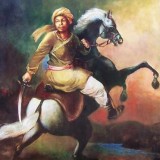
The Hindu Civilsation has given birth to many sages and warriors over its long history to survive and this is a short story of one of its greatest sons mostly known only within Assam but unknown sadly among most Hindus themselves..
In the mid 1600s the Mughal Empire was in the noontide of its glory – one of the greatest and largest empires in the world with a power army to match it. By force and conciliation it had overrun a large part of India before their fanatical policies of religious persecution led to a series of uprisings and revolutions that brought the entire empire crashing into the dustbin of history.

The Once Powerful Mughal Court
The event which is regarded as the keynote defeat of Mughal armies and the beginning of the fall of the Mughal Empire was the victory of the greatest Assamese Hindu warrior, Lachit Borphukan, who defeated the Mughals in the historic battle of Saraighat in April 1672.

The Mughal Emperor sent his greatest general, Mir Jumla, to conquer the land of Assam which was ruled at that time by the Hindu Ahoms. This valiant tribe had repulsed numerous attacks on their homeland from the time of Muhammad Ghori to the present, defeating no less than seventeen invasions.
A desperate fight ensued in the jungles and the valleys where the people rallied by Lachit Borphukan and the Hindu monks of the land in a war of liberation.

Ahom shiva temple
From the capital city of Guwahti to the depths of the forests the Ahoms fought and held back the tide of invasion. The proud warriors of Central Asia, Mughal and Pathan alike were foiled by the valiant resistance of the Ahoms.
Apart from being the headquarters of the Mughal Governor in occupied Ahom territory, Guwahati had great strategic importance. The Brahmaputra river between Kamakhya and Saraighat is the narrowest at Guwahati and there are hills on both banks of the river in this area.

Ahom Warriors about to attack
The area was densely forested and road communications were very poor. The Brahmaputra waterway was the most important line of communication. A large army moving in this region had to make use of the Brahmaputra waterway. Lachit first struck at Bargoda fort at the junction of Bar Nadi and the Brahmaputra.
The Mughal garrison was driven out from this fort and their counterattacks defeated. The Mughal reserves came up to the north bank and prevented further Ahom advance but could not dislodge them from Bargoda. Lachit Borphukan now shifted his attention to Sukreswar hill on the south bank where the Mughals had a fort, which was also the headquarters of the Mughul Governor. Ahom commandos managed to infiltrate the fort and neutralised the cannons by pouring water through their mouths and over their stock of gunpowder.

lachit borphukan leading the advance on the Brahmaputra
This was followed by a heavy cannonade by the Ahoms and a determined assault of the fort. Sayed Firoz Khan, the governor, was taken a prisoner. The Mughals abandoned Guwahati. Lachit Barphukan now advanced down the Brahmaputra to Manas recovering all the Ahom territory ceded to Mir Jumla. A stone victory pillar in the Guwahati museum has an inscription in Sanskrit praising Lachit Barphukan for his great victory against the Mughals.
An incident in the history of the Hindu Ahom resistance marks the spirit which animated their fight for freedom, when Lachit Borphukan, the Army General of Ahom king Chakradhwaj Singha had beheaded his maternal uncle for dereliction of duty while preparing to face the Mughals. His execution of his own uncle for not showing sufficient dedication to the war effort was not just an act of impulse but a reminder to his soldiers that in the service of one’s Dharma, it is not possible to adopt double standards of judgement.
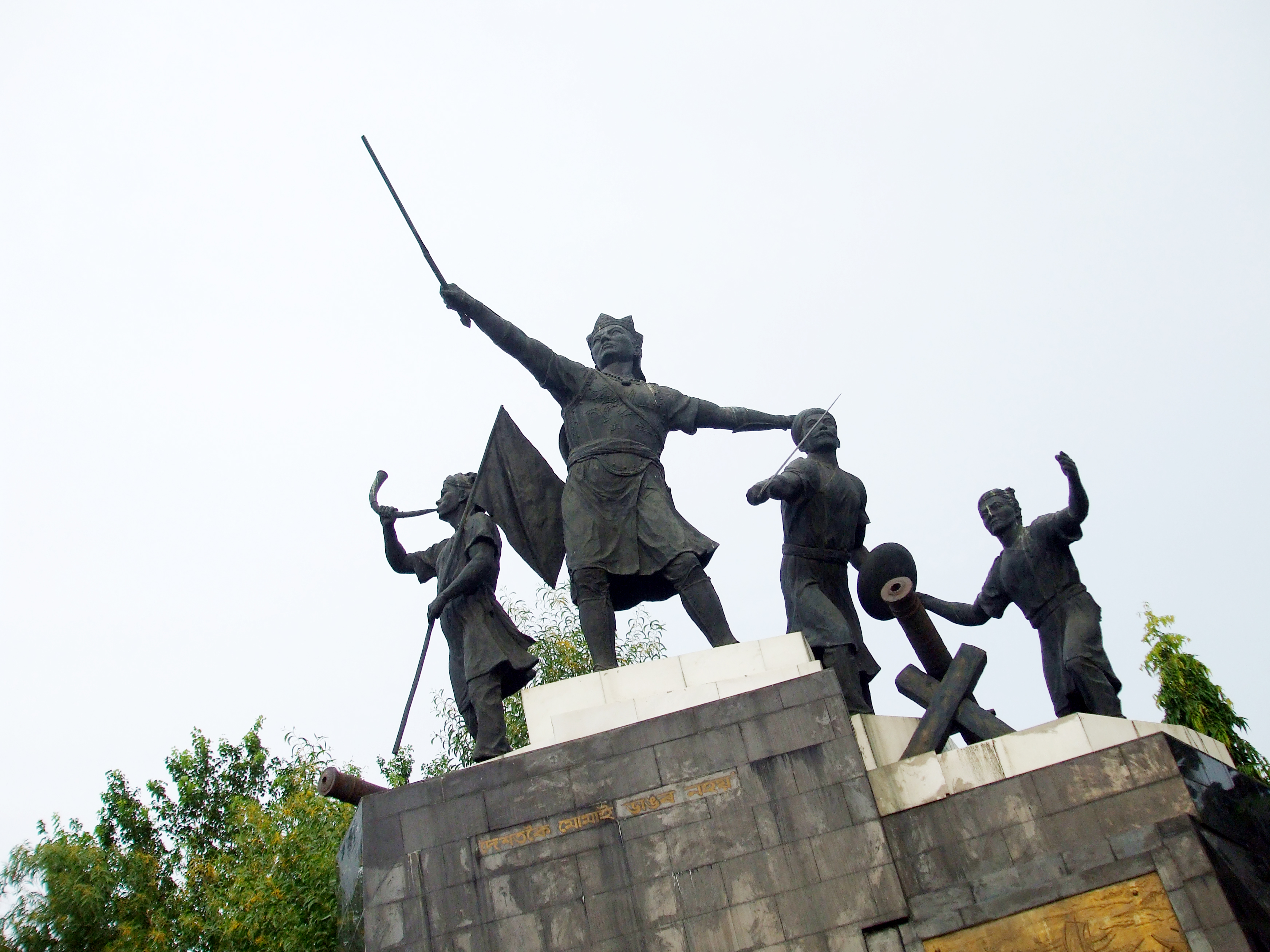
Lachit Borphukan memorial
Historians may have neglected Assam but history has not. History text books give details of the Indus Valley civilisation, the Ganges Valley civilisation and the Mughals, the British etc but they hardly mention the Brahmaputra Valley civilisation, when the history of Assam is unique. Unlike some Indian states, Assam did not succumb to the invasions of Delhi Sultans of Mughal Emperors and bloodthirsty tyrants and are a reminder of the preservation of freedom of thought and culture – the keystone of Hindu Dharma
Hindu Dharmashãstras have enjoined upon every Hindu to repay according to his or her capacity the rishi-riNa, that is, the debt we owe to our seers and sages, by passing on to the next generation the Veda and the Itihãsa-PurãNa, that is, the spiritual and cultural vision of Sanatana Dharma and the historical tradition of Hindu heroism… : Sita Ram Goel
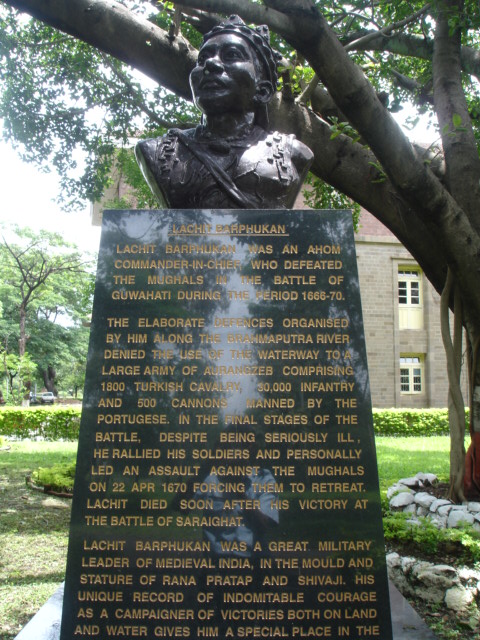
Statue of Lachit Borphukan at National Defense Academy : India
Author: admin
(10124)

admin
Latest posts by admin (see all)
- The Ideals of the Kshatriya – Warrior - July 28, 2022
- Testing post to check FB comments - June 2, 2021
- Ramakrishna Paramahamsa : The Eternal Mystic - April 17, 2018
Lachit Barphukan executed his own maternal uncle (MAMA) for dereliction of duty, such was his devotion. But for him and his valiant Ahom forces, Kamaakhyaa Mandir would have gone the way of Somnath and other 30000 temples sacked and destroyed in North India.
Dear webpage admins,
Get your facts right. Ahoms were not Hindu as you have mentioned. Ahoms adopted Hinduism later on. But it was never the way you have tried to portray. The war was all about protecting one’s own country rather than a Hindu fighting against the Muslim invaders. By the way the right hand man of Lachit Barphukan was a Muslim man, Ismail Siddiqui aka Bagh Hazarika. Moreover, people of Assam are not concerned with your idea of Hinduism. If you look back in time you will find India was never a Hindu nation per definition. It was a later construct. Assam was never a part of India. Only in 1826 the British made it a part of India. So do not try to portray us in your Hindu chauvinistic way.
Regards
Kharkhua Axomiya
P.S. I doubt if you even know what kharkhua means!!
India is a Hindu nation ,its time to let everyone know that and fuck this secular crap…………
[…] there was no empire of the Gajapati kings in Orrisa or the Ahoms in Assam giving the Mughals a resounding defeat in 1671. Imagine a land beaten down by the forces of Islamic […]
[…] there was no empire of the Gajapati kings in Orrisa or the Ahoms in Assam giving the Mughals a resounding defeat in 1671. Imagine a land beaten down by the forces of […]
When you write about Lachit, please do describe the war at Saraighat. It was the greatest victory. Ahom soldiers built temporary floating fortress on Brahmaputra and put cannons there. The defeated mighty Moghuls. Also please do mention dates.
Lachit Borphukan was a great patriot without doubt. We Assamese people are always proud of him. We have read about him since our very young days, and never ever we were told about his religion. He was a valiant warrior, a great patriot, one of the greatest Assamese ever. His religion was never important for us, not even today. So, why this article wants him to be a ‘hindu’ warrior? It’s very interesting that the writer of this article read so much about him, but failed to note Bagh Hazarika (Ismail Siddiqui), a muslim who was right hand man of Lachit Borphukan. Also, the writer gleefully forgot to mention that though Lachit Borphukan was fighting against Mughal empire, the chief commandant of Mughal Army was Ramsingh, a hindu. Why are we beginning to see everything under the lens of religion?
we are proud to have such great warrior in Assamese history.
At first I would like to thank the writer who brought Lachit Borphukan to the notice of the nation. But some points are incorrect.
1) Ahoms established themselves as rulers of Assam in 1228 AD after fighting numerous wars with local rulers of Assam composed of Indoaryan people as well as tribes like kacharis who are mongoloids.
2) First foreign invasion to Assam was led by Bakhtiyar Khilji who was a slave of Qutubuddin Aibak(Ghori’s general) and was routed by kamrupa ruler Prithu(Visvasundaradeva was his real name) and he was not ahom.
3) So, the Afghan, Turk & Mughal invaders were defeated by local Hindu Assamese warriors and later Ahoms fought and defeated them. Thus 17 times they were defeated not only by Ahoms but you should say Assamese( both ahoms and other Assamese groups which were both Indo-Aryan e.g, Kayastha etc and mongoloids eg Kacharis etc.