
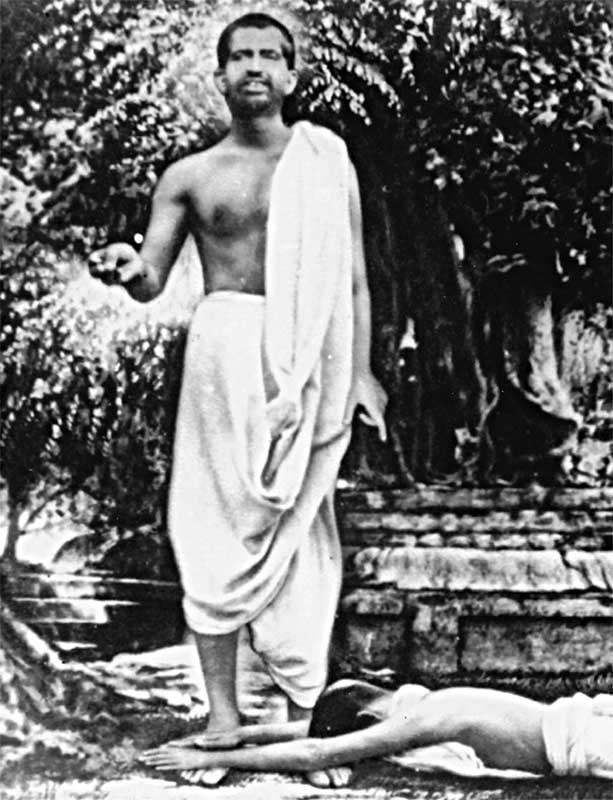
 Ramakrishna was born as Gadadhar into the Vaishnava-leaning pious brahmin family of Khudiram Chattopadhyay in 1836 in the village of Kamarpukur, now in West Bengal, India. This was the period when India was on the threshold of complete domination by the colonial superpower Britain, as described by Swami Nikhilananda in his foreword to the Gospel of Sri Ramakrishna: the old Maratha order was wilting, the East India company had decisively won the Anglo-Maratha wars, winning rule over the vast subcontinent.
Meanwhile they were setting up the capital of Imperial India in neighbouring Calcutta, in the heart of the rich province of Bengal, setting about Macaulay’s vision of producing Indians who were Indian only in colour but European by training and taste.
Graduating from the new Presidency College and other institutions of colonial power such as the various missionary run schools, young men and women had begun to abandon their traditions en-masse. Beef parties and drunken ribaldry mocking Hindu traditions were common on the streets of Calcutta. Economically, Indian industry and artisanship was being wiped out by British policies to export raw materials from India to feed Britian’s fledgling manufacturing. It seemed that the Hindu civilization that had endured over 5000 years, managing to reverse the severe onslaught by the Arabs, Turko-Mongols and Persinas would finally be over-run by the might of the colonial steam-press.
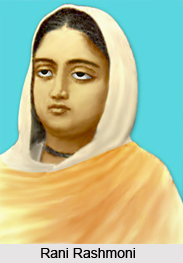 But the story of Dharma, as so often, is concealed more in the footnotes, by-lanes and the distant forests of time, rather than in the external happenings. On the outskirts of the giant metropolis of Calcutta, Rani Rashmoni, the wealthy widow of the Zamindar of Janbazar, had built a majestic temple complex dedicated to the Divine Mother in the form of Dakshina Kali, after receiving a vision.
So devoted was she, that Mother had promised to be ‘awakened’ in her temple. Henceforth the Rani transferred all her wealth in a trust in Mother Kali’s name and conducted the affairs of her business and estates as the Trustee. Located on the banks of the Hooghly river and on the path to the pilgrim site of Gangasagar, the vast complex also had shrines to Lord Shiva and Krishna, besides housing facilities to host wandering sadhus, jogis, bairagis and fakirs. In this remote temple and its jungle-like surroundings which included an old cemetery, were scripted the life and deeds of the sage which went on to storm the very foundations of the Raj.

Ramakrishna, who lost his father soon after birth, grew up to be an affectionate and sensitive child loved by all, and became the support of his mother. He was fascinated by the stories of the Gods and Goddesses of Hinduism.
When was just six, he had the experience of ecstatic self-absorption or ‘Samadhi’, while walking in the paddy fields, enchanted by the beauty of the natural setting for which the fertile Ganga valley of Bengal is still famous. A few years later he attained such a deep state of Samadhi while playing the role of Shiva during the winter-time ‘jatra’ village play, that his mother got frightened and henceforth forbade him from such activities.
He was a precocious child and mastered the teachings at the village school or ‘tol’ rapidly, and engaged in play with children of all the castes at the local mango orchard where he would often conduct plays. In his clear-sightedness and steadfastness to truth, he would even stand up to established social convention, as in the case when he dressed up as a woman, to question the patriarchy of his family’s patron and the village head, Dharmadas Laha – when the latter discovered him in the Zenana later, he understood that restricting women was not the way to maintain ‘family honour’.
During his Upanayana or the Hindu ceremony conferring the scared thread and commencing studies, he stuck to his word and took the first ‘bhiksha’ (collection of food since students were expected to live the humble lives of mendicants) from Dhani, the blacksmith woman who had been mid-wife at his birth and also took care of him through childhood. By his teen years, Ramakrishna gained widespread respect and even reverence from the village folk at Kamarpukur.
 Ramakrishna was thus already a mystic who was widely revered by the time he was invited to officiate as a priest in the Rani’s Kali temple, following his elder brother Ramkumar who advised the Rani on matters of worship.
In this enchanting place, Ramakrishna conducted what is the most well recorded campaign of spiritual practices that embraced the vast diversity of approaches available in the Hindu fold. In a moving episode, he first has direct vision of Ma Kali as the highest spirit and moving force behind the entire universe, as he is about to kill himself with the sickle attached to the image he worships in the shrine every day, unable to bear not seeing her for real.
Following this first and direct experience unguided by anyone, he trains under several Gurus, the chief of whom was the illustrious Bhairavi, a female tantra master who was divinely led to the Kali temple. Under the Bhairavi, Ramakrishna practiced the hoary techniques described in the 64 Shakta tantras, attaining perfection in each of them while uniquely remaining in the ‘Divya’ attitude that respects the mother aspect of the Divine. Under the guidance of Vaishnava babas, he practiced sadhanas of Sita, Hanuman and Gopala (baby Krishna). An episode of his vision of the baby Rama under the guidance of a baba of the Ramayat sect is utterly heart-melting.

All this culminates in his attainment of the most difficult goal of nirvikalpa samadhi, the highest and stated goal of Advaita Vedanta where the mind is merged in absolute Brahman and the body remains in suspended animation, under the guidance of the war-like naked itinerant monk Totapuri who was perhaps from the Punjab. Ramakrishna took a mere three days to attain this height which Totapuri himself had taken over forty years to reach, and in an act of heroic mystery, he remained in this state for several months at a go.
As with others, Ramakrishna also teaches Totapuri of the necessity to acknowledge Shakti, while similarly teaching the Ramayat Baba of detachment even to spiritual ideals, and disavowing the ego of a teacher to the Bhairavi. At this time, he also welcomed his wife Sarada lovingly to his dwelling in the temple complex, invoking the Deity in her in a stirring performance of the arduous Shodasi puja described in the tantras. Sarada devi later said that the years she spent in Ramakrishna’s divinely inebriated company were full of indescribable happiness, as if someone had placed a pitcher full of bliss in her heart. Their mutually loving and understanding relationship demonstrated that a union at the level of spiritual ideals is the very foundation and basis of a satisfying marital life.
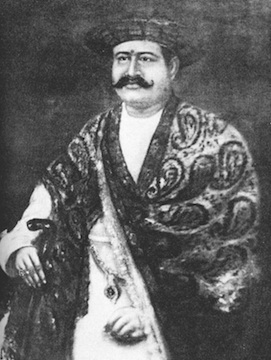
After twelve long and arduous years of spiritual disciplines and incomparable realizations of the truths described by the Hindu dharma, Ramakrsihna burst forth on the intellectual and elite circles of Calcutta. Already influential and wealthy members among the city’s elites who were recoiling from the spiritually vacuous and morally draining colonial ethos were flocking to him by this time. The Rani’s son-in-law and heir to her estates, Mathurnath Biswas was among the first to gauge the depth of Ramakrishna’s realizations.
The aristocrat Shambhu Charan Mullick, the Marwari businessmen from Calcutta, and many simple Hindus from various walks of life began to gravitate towards him. It was at this time that Ramakrishna also conducted unique inter-religious experiments, something that no Hindu sage has done before or after. Perhaps as if to alleviate and address the angst of the Calcutta people who were being slowly anglicized, after being battered by Islamic extremism already over several hundred years Ramakrishna sought to experience the spiritual paths in Islam and Christianity. At first, he listened to readings of the Bible by Shambhu Mullick, and in three days, he attained a vision of an angelic personality like Christ, with a voice proclaiming ‘here is the Son of Man who gave his blood to redeem all mankind’.
This was an epic act of the native Hindu genius showing that perhaps Christianity could be envisioned as a possible bhakti path centered around the person of Christ. This episode was a blow to the fanatic missionaries, and showed that contrary to their propaganda, it was not necessary to practice a militantly exclusive spirituality to gain access to the Truth that Christ had so famously said will set one free. Later Ramakrishna took initiation into a mantra from the Sufi Govinda Rai, and is said to have rapidly had an experience of God with attributes, the end goal of Sufi Islamic sadhanas.
These experiments showed that the framework of Hindu spirituality, centered around the seeking for a direct experience of the spiritual essence of all existence, was broad enough to accommodate even the traditions originating from outside India. These experiences of Ramakrishna bolstered and completely rejuvenated the battered psyche of Hindu Bengal and indeed across all of India and provided the basis for a new line of spiritually centered national unity, a concept that was later adopted by the pan-Indian independence movement.

In an act of spiritual inspiration, one day Ramakrishna visited Keshab Chandra Sen, the savant who headed the Brahmo Samaj, a Christian-leaning reformist Hindu movement that had captivated the educated elites and middle classes of Calcutta. That first meeting, where Ramakrishna spontaneously appeared before and clarified doubts raging in in him, was to completely transform Keshab.
Henceforth, he met Ramakrishna dozens of times, in the company of his many followers – sometimes on steamer boats on the Ganga, sometimes at spiritual gatherings at his home and at Brahmo meetings at others.
Ramakrishna’s rustic message pregnant with the native Hindu spiritual ethos backed by the sheer power of realization scandalized the anglicized members of the Samaj, so much as to cause a split, with a sizable section of the educated members completely adopting him.
This was to be a defining moment – with them, came the masses of Calcutta youths hitherto lost and numb before the glitz of the Raj. Prominent citizens such as Balaram Bose, Mahendranath Gupta, Ramachandra Dutta, Adhar Sen, Mnomohan Mittra, Sivanath Sastr, Ishan Mukhopadhya and Durgacharan Nag slowly overcame their inhibitions and skepticism and accepted Ramakrishna as their Guru.

There also followed the epic conversion of the Bohemian stalwart of modern Bengali Theatre, Girish Chandra Ghosh, who was a tormented soul riven between his upbringing and the rationalism of the time. Ramakrishna’s selflessly loving interactions with the sometimes repulsive and acerbic Girish mesmerized the literary, artistic and musical circles of Calcutta.
Female artistes such as Binodini became his ardent devotees, and to this day Ramakrishna is considered the patron saint of Bengali performing arts. As his fame spread, students from colleges and even women of aristocratic families sought refuge in Ramakrishna’s spiritual wisdom. Thus came Narendranath Dutta, Rakhal Chandra Ghosh, Baburam Ghosh, Sarat Chandra Chakravarty, Taraknath Ghoshal, Kali Prasad Chandra and several others, who banded together under the gentle and nourishing guidance of Ramakrishna at the Dakshineshwar temple.
Ramakrishna’s disciples included the whole breadth of Bengali Hindu society, including all classes and castes, and members of both sexes. Prominent female disciples included Golap Ma, Gauri Ma and Yogin Ma. The storm unleashed by his teachings gathered winds that were to later emerge as the Bengal renaissance, nucleus of the nascent Indian independence movement.
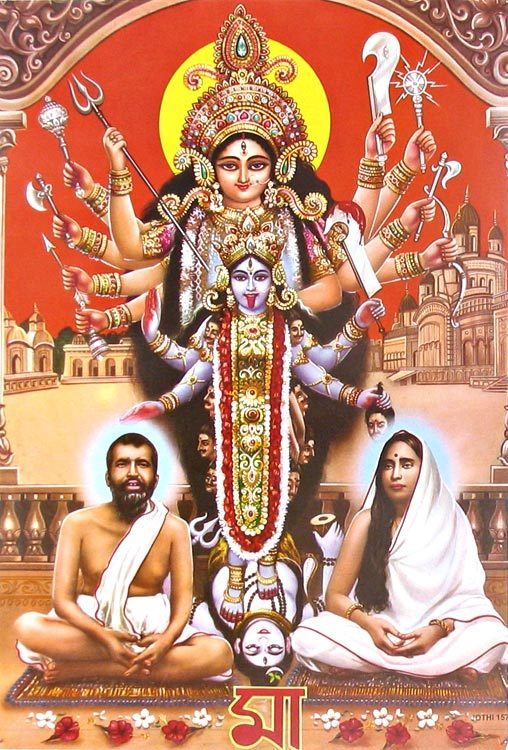 Like Buddha before, Ramakrishna did not take a dogmatic theological position, and rather encouraged the development of innate spiritual tendencies among aspirants, prescribing paths and techniques suited to their own temperaments. In Ramakrishna’s view, ‘God is with form, without form, and besides who knows what else’ – a vision that aptly captures at once the depth and diversity of Hindu spiritual traditions.
Direct experience was to him more important than dry debate and analysis, and by his own example, dancing to songs in praise of the divine at the public Harisbha’s and other events, Ramakrishna brought vibrancy and colour to the otherwise dulled spiritual atmosphere of anglicized Victorian Bengal. ‘Bhakti mixed with Jnana’ as prescribed by Narada, was his own preferred path and he converted many a skeptic including a vigorously doubting Naren into ardent devotees of Kali.
Ramakrishna also did not discriminate on the basis of caste or birth or sex to initiate someone into the spiritual path, taking in all those who he judged had the potential to ‘storm the gates of the divine’ as he himself had done before. His approach to teaching his disciples was revolutionary for his times, for he allowed them to completely cross-examine and test him, while delivering lessons in fables as much as through practical life episodes.
His non-dogmatic and flexible spirituality recognized and admitted every genuine aspiration for the divine, expressed in whatever manner and form, from orthodox Vedic worship, to heterodox tantric and non-Indian practices. ‘Vyakulata’ or earnest and passionate seeking for the divine was for him, the first and highest necessity of spiritual life. Through his experiences he had cut through the cobwebs that had accumulated over the vast and varied spiritual paths of the Hindu traditions.
His arduous spiritual practices and ceaseless engagement with ever increasing flow of disciples and devotees took a toll on Ramakrishna’s health, and in mid-1880’s he developed what was perhaps a cancer of the throat. The brief years of his severe illness brought together his disciples into a closely-knit community bonded in their common quest for the direct experience of the divine.
Soon after his passing away in 1886, his younger disciples renounced the world and took Sanyas, as per the wishes of Ramakrishna, led by Narendranath (later famous as Vivekananda) on Christmas eve at a fire ceremony at Bauram’s ancestral home in Antpur.
Gathering together as a monastic community, the young Sanyasis undertook severe austerities, while several of them including Naren also travelled across the country as initerant mendicants. Several years later, Naren was to take the West by storm by his opening address to the first parliament of world religions in America. Now known as Vivekananda, he also established the Ramakrishna Math and Mission, with an aim to make Hinduism ‘a strong missionary religion’ and promote the brand of direct spirituality espoused by his Guru.
In a series of stirring speeches delivered all across the cities on his path from his landing from America at Colombo to the Himalayan retreat of Almora, Vivekananda outlined his grand vision for a spiritual and material rejuvenation of India and Hinduism at large. His points on the basic unity of Hindu traditions and practical spirituality as outlined in these speeches, are still relevant. Vivekananda also produced classical translations of the foundational texts of Yoga-Vedanta in the form of his books on the four Yogas, which have since influenced generations of seekers across the world.
 Long before he attained fame, Ramakrishna had already been declared an Avatar, by several assemblies of traditional scholars, the most famous of which was the vigorus debate between Pandits Gauri and Vaishnavacharan held under the supervision of Mathurnath and the Bhairavi, perhaps in the 1850’s at Dakshineshwar. In Ramakrishna, India discovered herself, and he was certainly one of modern India’s first ‘God-men’, rooted in tradition yet modern in his outlook, co-eval with perhaps Shirdi Sai Baba on India’s western shores.
Ramakrishna’s life, experiences and ministry produced a intense churning among the youths of Calcutta and India at large, and after many hundred years, India’s sacred heritage now became the talking point among the common masses.
The themes of God, spirituality, the essence of life, absolute reality, causation and incarnation continue to be discussed today in India and all over the world. What were considered settled theological debates on topics such as image-worship, plurality of the Godhead and the exclusivity of revelation, have now rightly become topics for ardent reflection. Among the Gurus of modern India, Ramakrishna is unique not just for his multi-faceted personality and realization, but also for the fact he created a clear succession plan indicating ‘Naren will teach’, identifying the leader of his movement after him.
Succession is an issue that has caused the most number of schisms and bloodshed as seen in the history of the Christian Church and Islam, as well as among the recent Guru movements across the world. On his deathbed, Ramakrishna revealed to Vivekananda, ‘He who was Rama, he who was Krishna, is Ramakrishna in this body. And this, not in your Vedantic sense’ – those immortal words continue to echo through our skeptic times, and perhaps hold the key as Vivekananda himself later proclaimed, to the rejuvenation of humankind.
Endnote: It was the winter of 2006 – as snow capped everything in sight, a group of about 30 seekers gathered in a retreat center in the remote German village of Bindweide, around a diminutive but charismatic Hindu swami from India. In snapping cold, the wooden house with spacious halls that was located in an otherwise desolate snowy settings, came alive with the vibrancy of the quest. Some, seeking through their cooking, others in cleaning the house and surroundings, while yet others by volunteering at the shrine. The eclectic group drew upon many nationalities: ethnic Indians mingled with Germans, Swiss, British, Canadians and Americans.
The damp early hours resonated with readings from the Guru Stotram and the Gita, while the calm mornings and sleepy afternoons saw readings from ancient Vedantic texts and Vedantic readings of the Bible. Many wept for joy at the evening meditations. This is the first of what is now the annual December retreat at the newest center of the global monastic Order that now has over two dozen branches in the US, and dozens of centers all across the Americas, Europe and Asia. Over 100 years since it’s founding by the legendary guru Vivekananda who famously brought Yoga to the West, the Ramakrishna Mission continues to grow and touch people’s lives.
Prabhu Iyer
Author: admin
(2586)

admin
Latest posts by admin (see all)
- The Ideals of the Kshatriya – Warrior - July 28, 2022
- Testing post to check FB comments - June 2, 2021
- Ramakrishna Paramahamsa : The Eternal Mystic - April 17, 2018
I find this statement “Beef parties and drunken ribaldry mocking Hindu traditions were common on the streets of Calcutta” very interesting.
Not directly related to it though, i find our continuous narcissism about our culture etc extremely defeatist.
Conversions to Islam continue till date like during Ramakrishna’s time (not just Christianity). Given this and the subsequent events, what is the purpose of feeling proud of our spiritual Guru and our temples and saving the cow in this context. Our baggage is too heavy and defeated.
As such the article is informative.
Thanks for your comment – however the purpose of this website and this article is not as much narcissism as much as to uncover authentically, the history of our people. Yes conversions have continued, but the effect of Ramakrishna was the powerful catalyst to the renaissance in Bengal that went on to eventually become the pan-Indian freedom movement. We cannot blame the gurus alone for our condition – many of them work very hard to preserve the ancient and sublime heritage what lay Hindus don’t care about – but even after such super human efforts if the masses only want entertainment, who is to blame? The awakening has to spread and the zeal for that has to come from the masses.
How far we can attribute the freedom movement to the inspiration from Ramakrishna or any spiritual Guru is debatable, irrespective of the fact that we might try to see a relation in those contemporary events, actually separated by at least a decade or so. That catalysis should have in fact come even before the British when most of Hindus were getting converted.
And yes your article has more details than i could ever get in my childhood from Amar Chitra Katha. Thanks Sir.
I can have nothing negative to say or even positive to add unfortunately, to your elaborate and wholesome post.
But i can’t ignore the fact that British rule is passe and we are still facing the same civilizational crisis from external onslaught for centuries, but we attach more importance to our struggle with the British as though they are the only invaders.
Agreed the awakening has to come from the masses, and adding to the last sentence of my first para, i would say people like Chatrapati Shivaji Maharaj actually did more to save culture than the saints of Maharashtra, to feel otherwise in fact is wrong, misleading. So visionaries and warriors have done more to our civilization in inspiring the masses than saints.
The colossal statue of Buddha was demolished right in front of camera and Thiruvalluvar is being at times usurped by missionaries.
A warrior would not have allowed the statue to become dust, the saint will only ask people to pray.
It’s true this aspect has to be studied in more depth – but before Ramakrishna all the so-called Hindu renaissance movements were all pseudo-christian. Ramakrishna was at the heart of the rejuvenation and revivification of the native spiritual genius – and once Keshab and his branch of the Brahmos converted to his ideas, the masses of Calcutta followed. Anyway that’s not the main point of the article – the article seeks to bring out the forgotten details in the life of this Hindu spiritual colossus and how that shaped us.
Vivekananda said that in India always political unification follows spiritual rejuvenation. This is true historically and we cannot disparage one section of the Hindu society over another. We cannot think of Shivaji Maharaj without Samartha Ramadas or Hari and Bukka (founders of Vijayanagara) without Vidyaranya.
Yes there is a type of sainthood that is otherworldly but there is the self-acknowledged Hindu tradition of rishihood which everyone agrees is a few notches above sainthood and rishis always inspired heroes to defend dharma – in fact ‘brahma’ and ‘khshatra’ have to go together, as noted in the Vedas themselves. As per the Mahabharata in fact both are of the same stock through Rishi Deerghatamas who is said to have fathered most Kshatriya lineages after the massacres by Parashurama.
The aim of this site is to comprehensively cover the heroic self-defence all Hindu (and pagan) peoples against the onslaught of exclusive monotheism – and this must include Hindus who are warriors, sages, merchants and the commonfolk. I am sure articles on great Hindu vaniyas such as Jagat Singh or the farmer heroes like Suhal Dev or the tribal heroes such as Karia Munda will follow.
Agreed that we tend to focus more on otherworldliness these days, to the detriment of practical survival – but so we cannot veer to the other extreme and just focus on heroism. We need a dharmic approach and that means to learn balance which comes from seeing all parts of the whole and not just focusing on one or the other to the loss of all else.
Hi Sir,
I guess you are referring to Brahmo Samaj of those days as pseudo-Christian. I too have heard that they had no problem with beef. No Sir, i don’t mean to divert the topic, just letting you know that i got your point.
On the same lines Swami Vivekananda was able to convince an Arya Samajist that idol worship is not wrong, but again my contention is that we never made serious efforts to counter Islamic/Christian missionaries with the same reasoning and rather always lost and lost and lost.
Consequently we have “weakened” the “strongest” profounder and reviver of Sanatan Dharma in India, the “Arya Samaj” with our own reasoning and weakened it as against idol worship.
Believe me Sir they are still the “most effective” and open in our revival but are not nurtured sufficiently due to our prejudices. They were the most practical and strongest giving sleepless nights to the enemies of Sanatan Dharma, Swami Shraddhanand was killed because of this.
I am happy though not surprised that you knew about the influence of Swami Ramdas on Chatrapati Shivaji Maharaj given your knowledge on the subject.
But i refrained from mentioning this earlier and i am unable to comment on this because this aspect is now more strongly embroiled in the allegation that Samarth Ramdas’s contribution is exaggerated by Brahmins and so on. It takes an almost ugly turn today here in Maharashtra occasionally.
You are right Sir heroism cannot but succeed without the Sanskaras of a dharmic approach.
Till the time benevolent and enlightened materialism of the west completely overtakes the world, we will have to put up with this. This was just my take in what actually looks promising about the future.